
Hondani & Ishigane Area
Ishigane Settlement Site
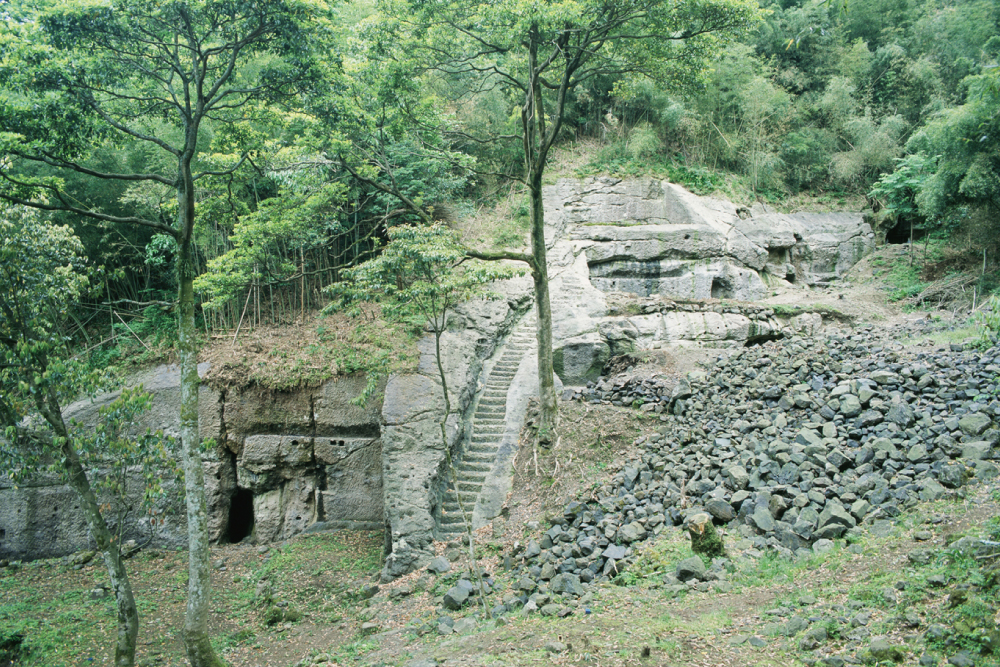
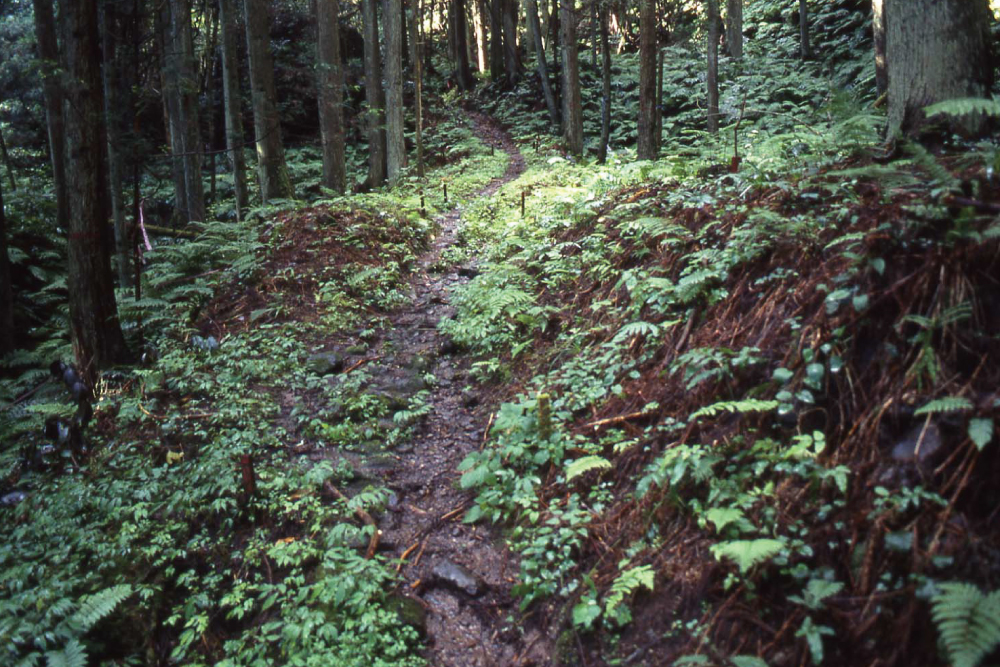
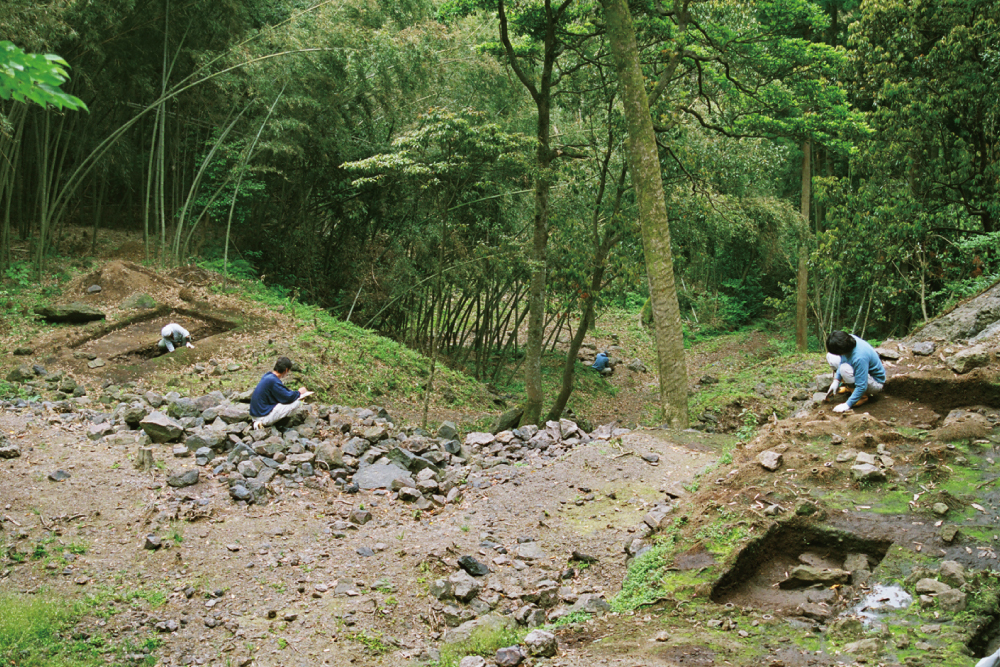
Near the summit of Mt. Sennoyama, around which the Iwami Ginzan silver mine grew from the mid-1500s onward, is a relatively flat, terrace-like expanse covered with low grass. This is Ishigane, where a major mining community flourished in the early 1600s. Populated during the silver mine’s greatest period of prosperity, the settlement centered on a road that led down the hillside into the Hondani valley, another important mining hub. This road, now reconstructed, was about 2 meters wide and lined with buildings on both sides.
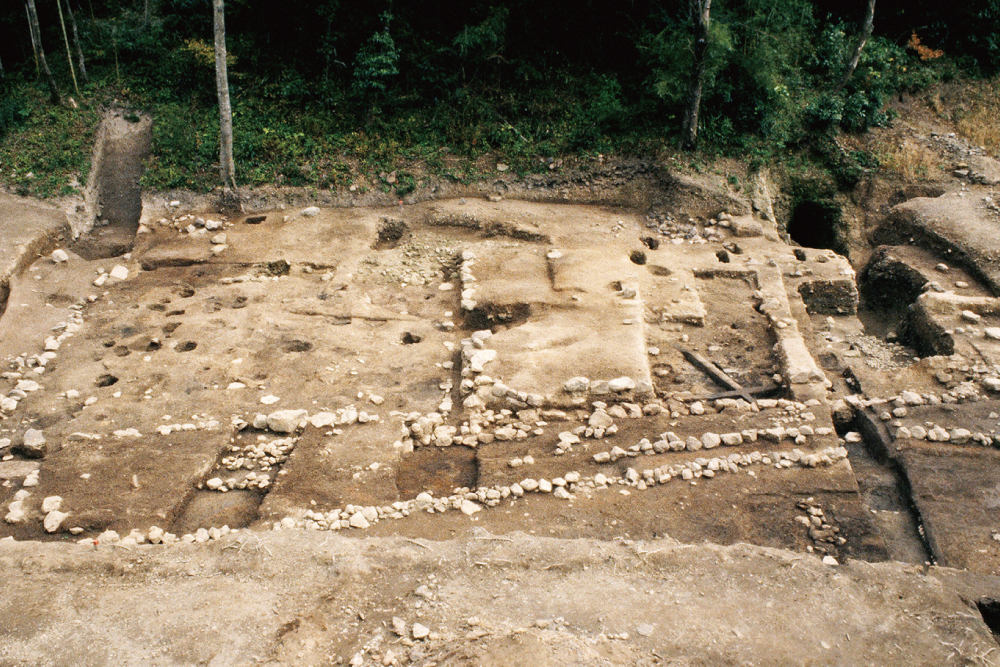
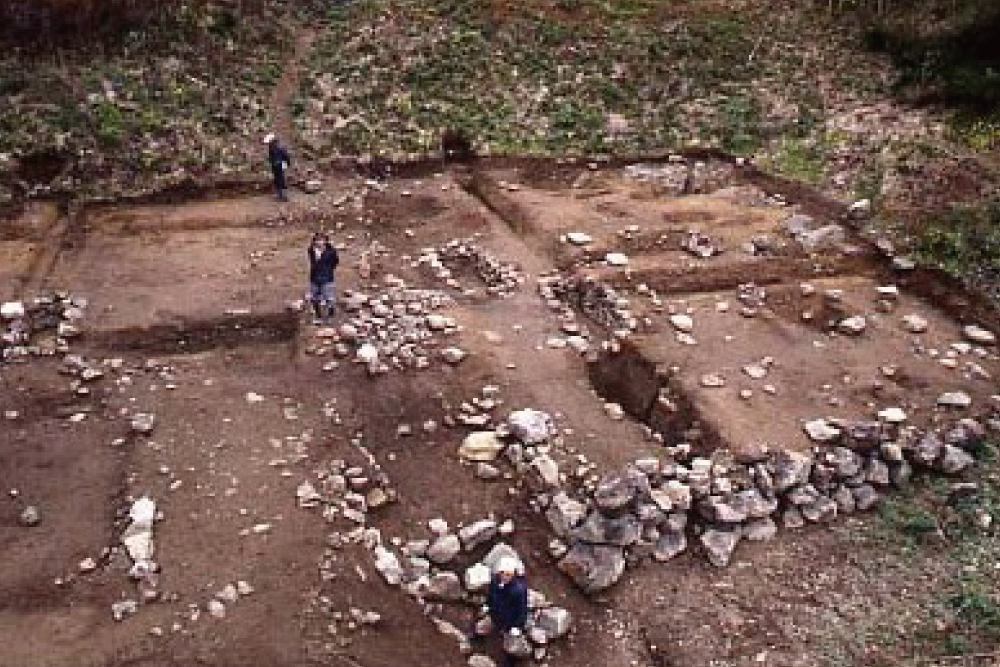
As evidenced by the remains of refining pits, crushed ore, and other items excavated here, miners and their families both lived and worked in these houses, dressing, smelting, and refining silver ore mined in nearby tunnels. The homes had clay walls for fire safety, and fresh water—a prerequisite for life in a place this isolated—was carried from a nearby well.
The stone foundations of one miner’s home and workshop have been partially reconstructed near the middle of the former settlement, in front of a narrow mining tunnel. The excavation of this site in the 1990s turned up one of the most significant archaeological finds in the modern history of Iwami Ginzan: a sixteenth-century iron pot that was used to refine silver using the haifuki (cupellation) method. Historical documents suggest that this technique, the key to producing high-quality silver at the time, was introduced to Japan from the Korean peninsula in 1533, but the iron pot discovered at Ishigane was the first physical evidence tying the haifuki method to Iwami Ginzan.
The excavation at Ishigane also helped shed light on the structure of mining communities at Iwami Ginzan. It appears that mining and processing silver was a job that families often performed together as units. One poignant find at the site was a lock of a woman’s hair tied to form an amulet of sorts, perhaps a lucky charm given by a wife to her husband to keep him safe down in the mines.
Ishigane Senjojiki Settlement Site
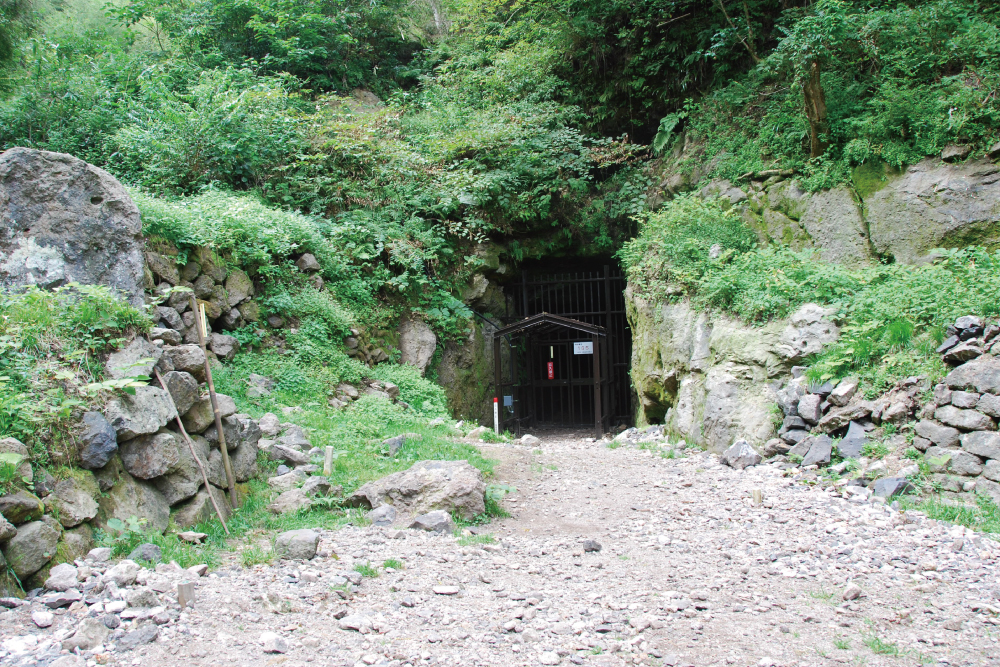
In the early 1600s, the relatively flat, terrace-like expanse near the summit of Mt. Sennoyama hosted several mining settlements, including Ishigane, Ishigane Fujita, and Ishigane Senjojiki. Populated during the Iwami Ginzan silver mine’s greatest period of prosperity, these settlements centered on a road that led down the hillside into the Hondani valley, another important mining hub. This road, now reconstructed, was about 2 meters wide and lined with buildings on both sides. The remains of refining pits, leftover ore, and other archaeological evidence discovered in the 1990s on the southeast side of the terrace, in what was once Ishigane Senjojiki, proved that miners and their families both lived and worked here, dressing, smelting, and refining silver ore mined in nearby tunnels. Their homes, which doubled as workshops, had clay walls for fire safety, and fresh water—a prerequisite for life in a place this isolated—was carried from a nearby well. None of the structures remain of what was once a large community (as suggested by the name Senjojiki, or “a thousand tatami mats”), but the openings of several mining tunnels can be seen along the hillside. The tunnels were dug using only chisels and hammers, and the time and effort required resulted in their being just wide enough for a miner to squeeze through.
Kamaya Mine Tunnel and Surroundings
The Kamaya tunnel is the source of one of the greatest success stories in the history of Iwami Ginzan. It was dug in 1602 by a prospector named Yasuhara Denbei, who soon discovered an abundant silver vein within. During the following year, Kamaya produced a remarkable 13.5 tons of silver for the shogunate, the central government in Edo (present-day Tokyo), which had assumed direct control of the mine a few years earlier. This contribution was so great that Yasuhara was granted an audience with shogun Tokugawa Ieyasu (1543–1616) and an honorary title, and he was presented with an ornate dofuku jacket and fan. The jacket was donated to Seisuiji Temple, where Yasuhara is said to have prayed before his discovery, and is now designated an Important Cultural Property. A reproduction of the jacket is on display at the Iwami Ginzan World Heritage Center.
Several mining sites from the early 1600s have been discovered in the vicinity of the Kamaya tunnel. In some, miners appear to have dug directly into the hillside rather than use tunnels, because the silver veins in this area were often very close to the surface.
Cliffs were also cut into to flatten the ground and make room for buildings. Nearby, pits were dug into the rock to collect rainwater, which was needed to wash the ore so that silver-containing bits could be collected effectively. These remains, along with byproducts of the silver-refining process found here, indicate that both sides of the valley that centers on the Kamaya tunnel were mined heavily from the time of Yasuhara Denbei through to the Meiji era (1868–1912), when the last shafts in the area were dug.
Okubo Mine Tunnel
Okubo is the largest tunnel system at Iwami Ginzan and one of the two main mining tunnels open to visitors on a regular basis.
It is one of the most thoroughly excavated parts of the silver mine, having been mined from the late 1500s until the Meiji era (1868–1912) and enlarged repeatedly over the centuries. Distinguished by its high entrance, the tunnel bears the name of Okubo Nagayasu (1545–1613), the first magistrate appointed by the Tokugawa government to oversee Iwami Ginzan.
Several smaller shafts branch out from the main tunnel, which is as high as 5 meters in places. These were dug to follow the veins of silver, traces of which are still visible here and there along the walls. There are also vertical shafts, some for ventilation and others that were used to route groundwater outside. The walls of the main tunnel are smooth where they were shaped by chisels and hammers. The tunnel was widened in the Meiji era to accommodate carts, so other parts of the walls bear marks of rough excavation techniques, including the dynamite used to widen the passage. Some cart rail crossties from this time are still visible on the ground.
Guided tours of the Okubo tunnels are given on weekends and public holidays from April to November. In winter the tunnels become the domain of hibernating bats, which can be spotted flying around inside year-round.
Hondani Settlement Site
Although it is now heavily forested and serene, Hondani (“main valley”) was one of the most important mining centers at Iwami Ginzan from the latter half of the 1500s to the late 1700s. A sizable settlement extended through the valley, where houses that also served as workshops for processing silver were built on flattened and terraced ground.
Near the entrance to the valley is the Okubo tunnel, the largest system of mining tunnels and shafts at Iwami Ginzan, and further down is the 800-meter-long Kinsei tunnel, dug to release groundwater from the Okubo system. Uphill along the valley, both sides are dotted with narrow tunnels and sites where miners appear to have dug directly into the cliff, because the silver veins in this area were often very close to the surface. Most of these sites have been reclaimed by nature and are difficult to spot, but some have been excavated around the Kamaya tunnel, which, in the early 1600s, sparked a dramatic increase in the mine’s silver output. Some of the stone walls built to fortify the terraced ground can also be seen here. Even further up is the entrance to the Honmabu (“main tunnel”), dug above one of the most abundant silver veins in the area. From here, the valley narrows as it continues up toward the summit of Mt. Sennoyama and Ishigane, the site of another major seventeenth-century settlement. Visitors should note that the path from Honmabu to Ishigane is not well maintained and can be difficult to traverse.
Hondaniguchi Checkpoint Site
When the central government in Edo (present-day Tokyo) assumed direct control of Iwami Ginzan in the early 1600s, a fence was built around the silver mine and checkpoints established at all exits to regulate the flow of people and goods into and out of the mining area. The guards at these checkpoints were tasked with ensuring that taxes were paid on goods entering the mine, that silver destined for the government’s coffers was not smuggled out, and that only people authorized to work and/or live in the fenced-off zone entered it. There were 10 checkpoints around the central mining area and many more throughout the Ginzan Goryo, the area under direct government control, which encompassed some 150 nearby villages.
Hondaniguchi oversaw the entrance to Hondani (“main valley”), one of the key mining centers at Iwami Ginzan until the late 1700s. Some of the mine’s most productive tunnels and shafts were in Hondani, and a significant number of miners and their families lived in this area. This made the twin checkpoints of Hondaniguchi and nearby Mizuochiguchi key nodes in the policing of the mine. Nothing remains of the checkpoint building, but a small mound by the road indicates its location.