
Iwami Ginzan World Heritage Center
Determining the Value of Silver
Silver Remaining at Iwami Ginzan
Ties Between Iwami Ginzan and Hội An
Ties Between Iwami Ginzan and the Silver Mine in Tarnowskie Góry, Poland
Getting Dressed
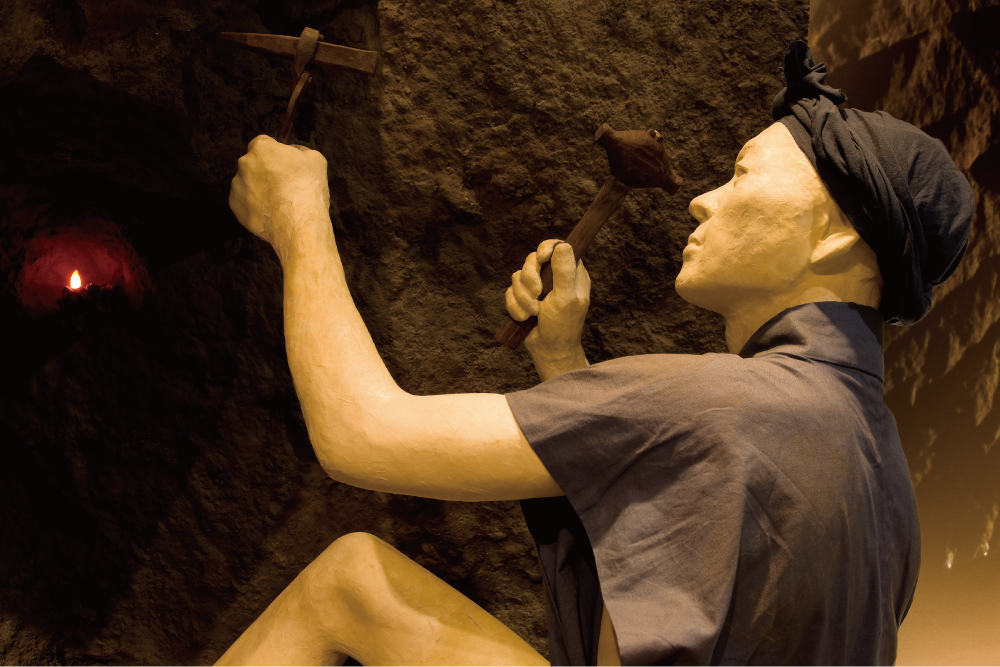
In the Edo period (1603–1867), miners at Iwami Ginzan were easy to distinguish from the general population. Instead of the usual long-sleeved kimono, they dressed in knee-length, sleeveless gray cotton robes tied with rope around the waist. This type of clothing was lightweight and easy to move around in while providing a measure of protection in the cold, dusty mining tunnels.
Miners often wore a cotton bandanna wrapped around their head; a straw bag hanging from the rope around their waist held hammers, chisels, and other tools. They would also strap a round straw mat to their buttocks to sit on while working. The straw half-sandals they wore on their feet covered only the front half of the sole. The main purpose of this footwear was to prevent miners from slipping on the damp rock inside the mine.
In one hand, a miner carried an oil lamp fashioned out of a seashell. All their work was done in the glow of these lamps, whose light reached only a few meters into the darkness. Beginning in the latter half of the 1800s, miners would sometimes wear a cloth mask stuffed with pickled plums. The citric acid in the plums helped them stay alert underground, while the mask protected them from the dust in the tunnels.
Entering a Mining Tunnel
Throughout much of the history of Iwami Ginzan, entering a mining tunnel meant going into a low, pitch-black opening in the mountainside that was only just wide enough for a miner to squeeze through. Entry into the mine was one of the most perilous moments in a miner’s day, as the risk of a cave-in was greatest at the mouth of the tunnel.
To prevent the tunnel entrance from collapsing, a thick reinforcing beam supported by four posts was placed above the entrance. This structure, called a yotsudome (literally “four-stop”), demarcated the mine from the outside world. It was a spiritual as well as a physical boundary: A yotsudome would usually have a small Shinto shrine on top of it, and miners would pray to the enshrined deity for protection before stepping into the darkness of the mountain.
The yotsudome lent its name to another barrier miners had to cross on their way into the mine. The yotsudome yakusho, located next to the entrance to a tunnel, was a checkpoint that operated under the direct control of the shogunate. Officials stationed at these checkpoints would ensure that only people authorized to work inside the mountain entered, and they weighed the silver ore carried by miners as they left the mine.
In addition to offering prayers, miners on their way into the mine calmed themselves with tobacco. The number of pipes excavated at Iwami Ginzan suggests that smoking was a widespread custom.
Digging Tunnels
Before the introduction of modern drilling equipment and dynamite, digging a mining tunnel was an arduous and extremely time-consuming task. Tunnels were dug using only hammers and chisels, and were made just wide enough for miners to pass through in single file because of the time and effort required. With the rock at Iwami Ginzan being relatively brittle, a pair of miners digging for an entire day could make around 30 centimeters of progress, which was impressive for the techniques of the day.
The iron chisels (gads) they used wore down fast and had to be replaced frequently. If they were still long enough to use, the chisels would be repaired by blacksmiths stationed outside the mine. These specialists also made and repaired other tools, such as the pliers that miners used to hold their chisels steady. Making new tools and maintaining old ones was never-ending work. Large quantities of iron were regularly brought in from furnaces in the Chugoku mountains (on the southern border of today’s Shimane Prefecture) to supply the blacksmiths’ workshops.
The walls of the Ryugenji Mabu Mine Shaft still show marks left by miners’ chisels centuries ago. However, these walls are comparatively smooth where they were shaped by hand. Other parts of the tunnel bear more recent marks of the rougher excavation techniques used to widen the passage in the Meiji era (1868–1912).
Carrying Ore
Hauling rock out of the mining tunnels was back-breaking, never-ending labor that was assigned to different workers, depending on the value of the rock. Miners usually carried out the valuable silver-containing ore they had excavated themselves, while rock deemed worthless was hauled out from the mine by helpers who could be as young as 12.
Toiling in the faint light of oil lamps, these workers used ropes to strap rocks weighing up to 15 kilograms to their backs, in some cases carrying them hundreds of meters through narrow, uneven mining tunnels. They used coarse cloth backpacks to haul smaller rocks and gravel.
According to a log entry for the Ryugenji Mabu Mine Shaft from 1858, the work was divided into two shifts, day and night, and performed by a total of 39 workers. Of these, 24 were miners, 5 were rock haulers, and 10 were children around the age of 10, who assisted the miners by carrying their tools, holding lamps, and similar tasks.
Securing a Tunnel
Cave-ins were a constant concern at Iwami Ginzan, and throughout the history of the mine great efforts were made to prevent them. Carpenters played an essential role in shoring up the mining tunnels by crafting and installing sturdy supports that fit the uneven walls of the mines. These struts were usually made out of chestnut or some other particularly durable type of wood. Carpenters were also called on to perform regular maintenance work in the tunnels.
A new method for reinforcing mining tunnels was introduced at Iwami Ginzan in the first half of the nineteenth century. When a new tunnel was dug, carpenters would line it with a wooden framework. Within this framework, specialist builders working inward from the mouth of the tunnel then set in place curved stone segments that had been pre-cut to fit, somewhat like the concrete ring stones used to reinforce modern-day tunnels.
A similar process can be seen in contemporary tunnel engineering, in which a temporary support structure known as a shield is used to secure the section of the tunnel being excavated before it is lined with concrete segments.
Draining the Mine
Draining water from the mine was one of the greatest challenges for miners throughout the history of Iwami Ginzan. As mining tunnels were dug longer and deeper into the mountain, the miners would inevitably hit pockets of groundwater in the rock, which flooded the tunnels and impeded the extraction of ore.
Over the centuries, several kinds of pumps were used to remove water from the tunnels. The earliest of these, thought to have been introduced in the early 1600s, were made of wood and bamboo. Some had a syringe-like mechanism, while others consisted of a series of square buckets set up in a stair-like structure. These pumps allowed workers to move water upward into a drainage channel or sump pit without having to carry it there in actual buckets, although buckets were also used at times.
Another solution to the problem of flooding was to dig shafts down to meet horizontal tunnels excavated at an elevation lower than any existing mining sites. Water would flow down into these new tunnels and be released into a river. The water-release shafts in the Ryugenji Mabu Mine Shaft emptied into a network of tunnels and shafts about 100 meters further underground called the Eikyu system. This network was dug between 1693 and 1787 to service multiple mining sites in the area.
Ventilation
The air deep within a mining tunnel was often low in oxygen and dusty from the particles released during ore extraction, as well as soot from the oil lamps miners carried. Respiratory diseases were common among mine workers.
Over the centuries, the administrators of Iwami Ginzan took many steps to improve air quality inside the mine. They had ventilation holes and shafts dug, and from the 1700s onward they used modified winnowing machines (used in farming to separate chaff from grain) to pump fresh air down into the shafts. In long mining tunnels, several of these machines were placed at carefully considered distances from each other so that air could be sent all the way to the end.
In addition, the drainage channels that ran along the sides of many mining tunnels were also used to improve air quality. The channels were covered with wooden boards and clay so that they could double as air ducts.
Evaluating Ore
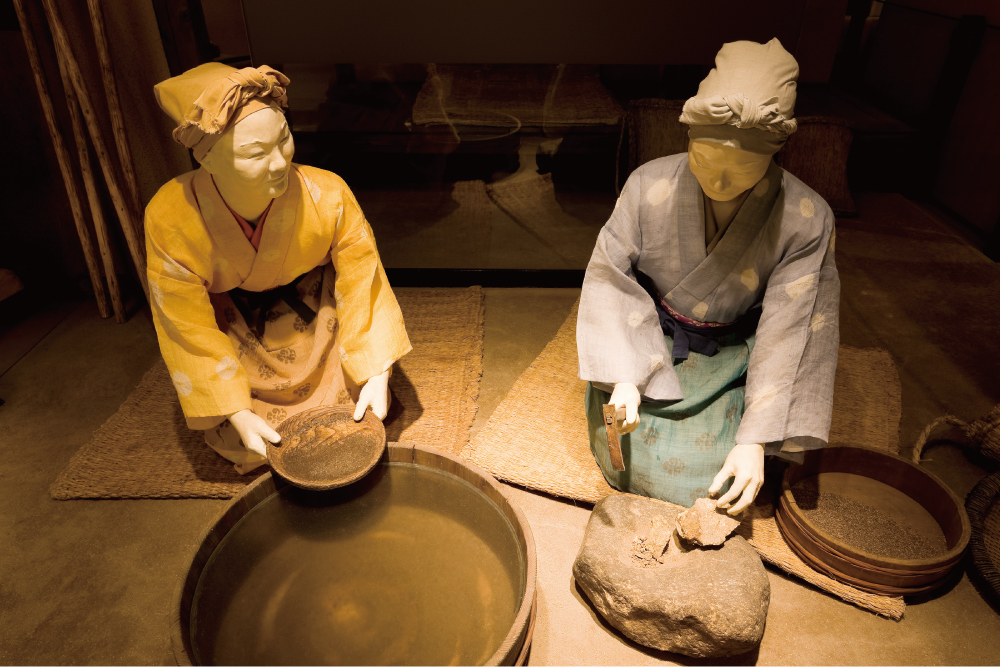
Every piece of ore that was carried out of the mine was evaluated by specialized workers. They began by removing small stones and dirt from the ore, then crushed the ore with hammers and chisels. Next, they sifted through the resulting pieces to isolate the parts containing silver.
Meanwhile, women and children living within the mining area were put to work sorting bits of ore deemed low-grade by miners and discarded in piles outside mining tunnels and shafts. This seemingly menial work served an important purpose by training the next generation of miners to evaluate ore.
In parts of the mine, the ore was apportioned after it had been evaluated. Ore extracted from shafts administered by independent prospectors was divided into two portions: one for the miners and the other for the magistrate’s office, which was the government authority in charge of Iwami Ginzan as a whole. The ratio of this apportionment varied throughout the history of the mine. According to a document dated 1747, the magistrate’s office received a third of the ore in some of the most productive parts, while miners received two thirds.
Determining the Value of Silver
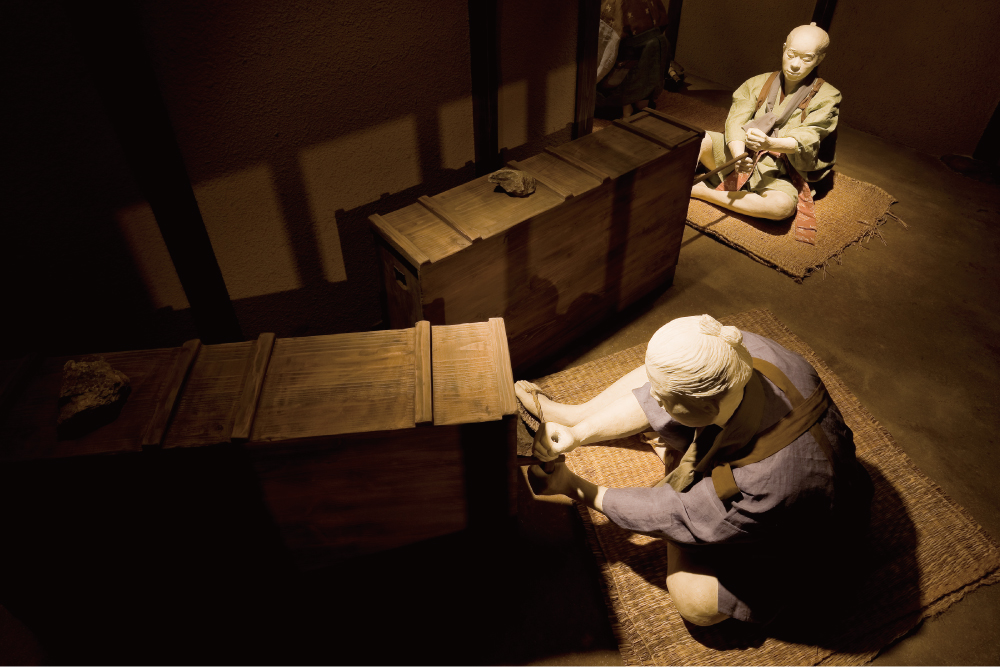
Once silver had been smelted and refined at the mine, it was moved to the town of Omori, where it was weighed by specialist officials to determine its purity. The silver was then marked with the seal of the magistrate, the government official in charge of Iwami Ginzan, and packed for transport.
The silver that left Iwami Ginzan for the mints in Kyoto and Edo (present-day Tokyo) was the raw material for coinage. During the Edo period (1603–1867), the ruling Tokugawa shogunate regulated the amount of silver in circulation and the value of silver money, making use of monetary policy much as a modern-day government would. It set fixed rates of exchange for gold, silver, and copper; issued more silver coins when it sought to stimulate the economy; and decreased the silver-to-copper ratio in coinage when its finances were weak.
Transporting Silver
Transporting the silver mined and refined at Iwami Ginzan was a logistical feat performed for centuries by horses, oxen, and humans. In the early history of the mine, these hard workers had to cover only a short distance with such heavy loads. Between the 1560s and the first few years of the 1600s, silver from Iwami Ginzan was shipped to markets both in Japan and overseas from small inlets near what is now the town of Yunotsu. These ports were connected to the mine by a 14-kilometer road over hilly terrain. Only oxen were strong enough to traverse this uneven and often muddy path with boxes full of silver strapped to their backs.
In the early 1600s, Iwami Ginzan came under the control of the Tokugawa shogunate, the new central government based in Edo (now Tokyo). The shogunate ended silver transports to the coast, directing them instead over land to the port of Onomichi on the Seto Inland Sea, and from there to Osaka and on to Kyoto and Edo. Oxen were still used in mountainous areas, but horses carried the silver most of the way on a journey that took four days. Initially, several shipments were made each year. From the 1670s until 1865, however, there was only one annual procession consisting of up to 300 horses and 400 people transporting a year’s worth of silver.
The Use and Value of Silver
Silver mined at Iwami Ginzan flowed into the world economy and buttressed the 265-year rule of the Tokugawa shogunate. The metal was used as currency in Japan for centuries.
Use in foreign trade
From an international perspective, the most significant period in the history of Iwami Ginzan came soon after the discovery of the mine in 1527. From the mid-1500s onward, the local warlord-led families that controlled the mine used the silver for foreign trade. Demand came from Ming China, which had recently moved to a silver-based economy and needed vast quantities of currency to finance the defense of the empire against Mongol forces encroaching from the northwest.
Silver initially flowed from Japan to China directly, but this trade was soon taken over by Europeans. Portuguese traders based in Macau bought Chinese silk and exchanged it for Japanese silver, which they then sold to the Ming. This pattern of trade greatly enriched the Portuguese, who came to refer to Japan as “the silver islands” and circulated Iwami silver throughout their maritime empire. As the Spanish and Portuguese empires expanded global trade in the latter half of the 1500s, silver became perhaps the most in-demand commodity in the world. It is now estimated that around 10 percent of all the silver traded around the globe during this period came from Iwami Ginzan.
Use in the domestic economy
The international exchange of Iwami silver flourished until the late 1500s, when an influx of South American silver into the world economy reduced profitability for Japanese traders. The consequent availability of large quantities of silver for domestic use led the government of Toyotomi Hideyoshi (1537–1598) to introduce the country’s first standardized silver currency. Hideyoshi’s successor, Tokugawa Ieyasu (1543–1616), formalized the use of silver coinage and set fixed, weight-based rates of exchange for gold, silver, and copper. Silver currency remained the key medium of exchange throughout the Edo period (1603–1867). However, due to the slow decline in silver production at Japanese mines including Iwami Ginzan, the Tokugawa shogunate had to import silver to meet domestic demand from the 1760s onward.
The weight-based currency system, and with it the primacy of silver, came to an end after the Meiji Restoration of 1868. The new government of Emperor Meiji (1852–1912) began issuing Western-style gold coins alongside silver coins, and in 1897 formally adopted the gold standard. Nonetheless, silver coins remained in circulation for decades; the last of them were minted in 1966.
Silver today
Commercial-scale silver mining ended in Japan more than half a century ago, but domestic industrial demand for the metal remains significant. Silver is used widely in electronics, vehicle components, and medical devices due to its excellent electrical conductivity, antimicrobial properties, and reflectivity. Other uses include water purification, mirror coating, and, more familiarly, jewelry and tableware. Japan imports silver from Mexico, Peru, South Korea, and Australia, among other countries.
Silver Remaining at Iwami Ginzan
Even after nearly 400 years of mining, plenty of silver remains within Mt. Sennoyama, the mountain at the center of the Iwami Ginzan Silver Mine. However, the ore is dispersed and difficult to reach. All abundant veins discovered at the mine were excavated long ago, so extraction of meaningful quantities of silver would be extremely difficult and prohibitively expensive to carry out.
These circumstances led to the end of commercial mining at Iwami Ginzan in 1923, and hampered a short-lived attempt to restart operations at the mine during World War II. Since 2007, the mine itself and the sites directly related to it, from mining settlements to transportation routes and ports, have been protected as a UNESCO World Heritage Site. All prospecting and mining rights to Iwami Ginzan have expired or been transferred to the local government, ensuring the conservation of the site for future generations.
Ties Between Iwami Ginzan and Hội An
In the 1500s, vast quantities of silver mined at Iwami Ginzan helped lubricate a world economy dominated by the Spanish and Portuguese empires. One of the trading hubs through which the silver flowed to faraway markets was the Vietnamese city of Hội An, the most important commercial port on the South China Sea at the time.
Demand for Iwami silver came from Ming China, which had recently moved to a silver-based economy and in 1567 ended its longstanding prohibition on maritime trade. Due to the lack of a formal trade agreement between China and Japan, the Portuguese came to play the role of intermediary. They exchanged Chinese silk for Japanese silver and shipped the metal to Hội An to be sold to Chinese traders. The wealth engendered by this exchange allowed the city on the Thu Bồn River to prosper as a cosmopolitan crossroads.
Direct ties between Iwami Ginzan and Hội An were severed in the early 1600s, when the newly installed Tokugawa shogunate restricted the sale of silver overseas. Commercial exchange between the city and Japan continued, however, this time under a treaty between the shogunate and the Vietnamese kingdom of Đàng Trong. Between 1604 and 1635, up to 70 “red seal” ships—so called because they carried red-sealed letters of permission from the shogunate to engage in foreign trade—sailed from Nagasaki to Hội An. There they procured goods such as silk, sugar, and agarwood, a tropical commodity highly valued for its aromatic and medicinal qualities.
This exchange gave rise to a Japanese quarter in Hội An. In the first half of the 1600s, several hundred merchants are thought to have lived in this district on the western edge of the town, where dozens of Japanese-style houses stood in rows along the river. The Japanese quarter declined in the late 1630s, after the Tokugawa shogunate adopted an isolationist foreign policy and ended direct trade with Vietnam. The Chinese merchants who took over the district gradually transformed it, including by redecorating the Japanese-built bridge at its center in a Chinese style.
The long-dormant relationship between Iwami Ginzan and Hội An was revived following the mine’s designation as a UNESCO World Heritage Site in 2007. The old town of Hội An, where the aforementioned “Japanese bridge” is located, had received the same designation in 1999. An annual Japanese festival was held in Hội An until 2024.
Ties Between Iwami Ginzan and the Silver Mine in Tarnowskie Góry, Poland
Silver was discovered at Iwami Ginzan in 1527, and the mine remained in operation until 1923. This nearly 400-year period of activity overlaps closely with that of the silver mine in Tarnowskie Góry, Poland, which was opened in 1526 and closed in 1913. Both mines are now UNESCO World Heritage Sites, and there are currently several efforts to facilitate interaction between officials and academics from the two locales.
From its establishment to the end of the sixteenth century, the Tarnowskie Góry mine was an important source of lead and silver, both of which were extracted from galena (lead glance) ore. The silver was used mainly for coinage by local rulers, while around 80 percent of the lead was exported to other mining centers in Central Europe, where it was used to refine gold and silver, as well as for other purposes.
However, at both Tarnowskie Góry and Iwami Ginzan, removing water from the mine presented a difficult challenge. As mining tunnels were dug ever longer and deeper, the miners would inevitably hit pockets of groundwater in the rock, which flooded the tunnels and impeded the extraction of ore. The struggle against water was especially problematic at Tarnowskie Góry, which experienced almost three times the water inflow of other key mines in Europe. To overcome this problem, a drainage system was developed consisting of more than 150 kilometers of tunnels, passages, shafts, and transport corridors. The mine’s well-preserved water management system was one of the main reasons for its World Heritage designation.
The Tarnowskie Góry mine was modernized and mechanized under Prussian rule from the late eighteenth century onward. Metals mined at Tarnowskie Góry contributed to the rise of heavy industry in Germany during the nineteenth century. By the early twentieth century, the galena deposits were depleted, forcing the mine to close.
Exchanges between Iwami Ginzan and Tarnowskie Góry were initiated following the designation of the Polish mine as a World Heritage Site in 2017. Representatives from the city of Oda, where Iwami Ginzan is located, visited Tarnowskie Góry in 2023 to deepen ties with the Tarnowskie Góry Land Lovers’ Association, the NGO that manages the mine and has been instrumental in its conservation.
Iwami Ginzan and Mines in Taiwan
The ties between Iwami Ginzan and two historic mines in northern Taiwan date back more than a century and remain strong to this day. Japanese colonial policy in the late 1880s sowed the seeds of this relationship, which today encompasses collaborative historical research and joint initiatives between museums in the two countries.
Colonial context
Following its victory in the First Sino-Japanese War (1894–1895), Japan acquired Chinese territory, including the island of Taiwan, and became a colonial power. At this time, Iwami Ginzan was controlled by the Fujita-gumi corporation, which had obtained rights to the silver mine in 1886 and also operated mines in other parts of the country. Fujita-gumi was struggling financially, however, as its mines were not sufficiently profitable. In 1896, the Japanese government, eager to develop its newly acquired colony, distributed claims to two promising mines in Taiwan. Fujita-gumi seized the opportunity and was awarded the Ruifang gold and copper mine near the town of Jiufen in the northern part of the island.
Japanese mining in Taiwan
Fujita-gumi invested heavily in its Taiwanese holdings, introducing cutting-edge mining and refining equipment and technology, some of which had been developed at Iwami Ginzan. Many engineers and other specialists were also transferred to Ruifang after proving their worth at Iwami Ginzan, and an active exchange of personnel took place between the two mines. Jiufen grew into a bustling town that survived a critical situation in 1923, when Fujita-gumi abruptly abandoned its Taiwanese operations. In the same year, low copper prices on the world market forced the company to close its operations at Iwami Ginzan.
Japanese mining in Taiwan continued at the Kinkaseki (Jinguashi) gold mine near Jiufen. In 1935, Kinkaseki was the most productive facility of its kind in the Japanese empire, generating up to 2.6 tons of gold annually. It operated until 1987 and is now a designated historic site.
Amicable ties
Today, the history of mining in the Jiufen region can be explored at the New Taipei City Gold Museum in Ruifang. Researchers from the Gold Museum have collaborated with their counterparts at the Iwami Ginzan World Heritage Center since 2010. The two sites actively exchange information and have held a number of joint exhibitions and events in recent years. The institutions concluded a sister-museum agreement in July 2025.