
Ryugenji Mine Shaft and the surrounding Area
Glossary: Branch Shafts (hioiko)
Glossary: Drainage Shafts (sosuiko)
Otani Refinery Site
Round holes, unnaturally smooth flat surfaces, and deep diagonal crevices are visible along the moss-covered rock walls here. These marks of human hands are all that remains of a silver refinery that was a key part of the highly specialized economy that centered around the Iwami Ginzan Silver Mine. The refinery is thought to have been operated from the mid-1700s under the supervision of the magistrate appointed by the Tokugawa shogunate (1603–1867) to oversee the silver mine. The holes held roof beams, while the flattened rocks may have been workbenches. The crevices were made by miners digging directly into the hillside to reach silver veins, which in this area were often very close to the surface.
Refineries such as this one were vital to the production of large quantities of high-quality silver. Ore brought here from the mine was first crushed by workers who then sifted through the resulting stones to isolate the parts containing silver. These were then processed using the haifukiHaifuki involves smelting copper-containing silver ore together with lead. The silver binds to the lead, forming an alloy. This alloy is then placed on a bed of ash and heated to as high as 850°C, with bellows used to keep the mixture oxidized. The other elements of the alloy eventually melt and are absorbed by the ash, leaving only pure silver. Byproducts of this process have been discovered throughout the Otani site.
Once refined here, the silver began its long journey to the government’s coffers. It was carried down to the magistrate’s office in the town of Omori, where it was weighed to determine its purity and its quantity recorded. The silver was then transported overland to the port at Onomichi and from there by sea to Osaka and Edo (present-day Tokyo).
Silver Veins
The cliffs across the river here are covered with diagonal cuts and cracks—fissures that indicate where veins of silver run through the rock. Many of the cuts are deep, and the openings of narrow tunnels can be seen near some of them. Miners began digging into this hillside in the mid-1500s with chisels and hammers. After extracting silver ore from veins close to the surface, they dug tunnels and shafts to be able to follow the often-abundant veins deeper and deeper into the mountain.
As can be seen here, the silver veins running through Mt. Sennoyama, the ancient volcano at the center of the Iwami Ginzan Silver Mine, were both numerous and comparatively easy to reach. This was due to a fortuitous geological process that began some 1.5 million years ago, when a volcanic eruption caused a pileup of extremely hot ash and partially hardened lava. This material solidified into a mountain composed of rock that was relatively brittle.
As volcanic activity continued beneath the newly formed mountain, magma heated groundwater from below, releasing elements such as silver and copper from the nearby sediment into the water. The metal-containing liquid then seeped upward through cracks in the bedrock, penetrating the porous Mt. Sennoyama and distributing silver throughout the mountain. As the liquid cooled and solidified due to changes in temperature and pressure, countless silver veins were left in the coarse rock.
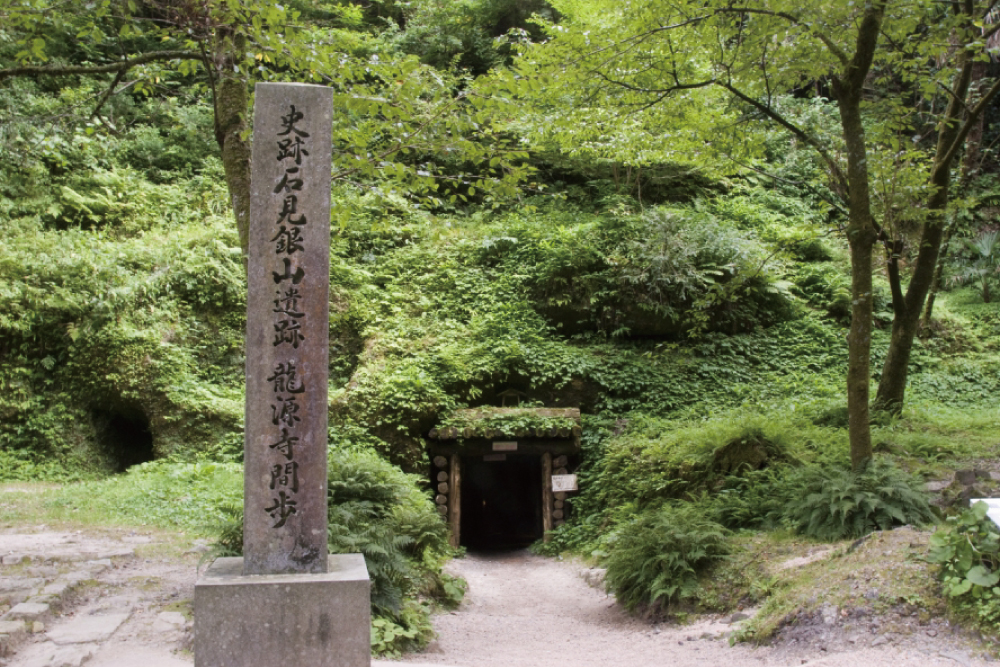
Ryugenji Mabu Mine Shaft
The mine shaft you are about to enter is perhaps one of the most significant of the nearly 1,000 mining tunnels and shafts that have been discovered at Iwami Ginzan. Ryugenji Mabu was opened in 1715 under the direct administration of the Tokugawa shogunate via the local magistrate’s office and operated for two centuries. It was extended several times over the years, eventually reaching a length of nearly 600 meters. The first 177 meters are now open to visitors. The silver mined here was an important source of revenue for the shogunate, which ruled Japan between 1603 and 1867.
The original tunnel was dug using chisels and hammers and was only just wide enough for miners to squeeze through in a single file. The many shafts that branch out from the main passage, which were dug to follow silver veins, give an indication of the extremely confined conditions miners worked in. The main passage does not seem as confined because modern drilling equipment was used to expand it to accommodate carts in the latter half of the nineteenth century. Vertical shafts, some up to 100 meters deep, were used to drain groundwater away from the miners and prevent flooding within the mine.
Although mining at Ryugenji Mabu ceased a long time ago, there is still plenty of silver in the ground here. One telltale sign of this is the presence of the Asian common lady fern (hebino-negoza), a low-growing, bright green plant with arching fronds that thrives in soil with a high concentration of heavy metals.
The Struggle Against Water
Several dark chasms are visible within the Ryugenji Mabu Mine Shaft. These are vertical shafts, some more than a hundred meters deep, which were used to drain water out of the tunnel. Draining the mine was one of the greatest challenges for miners throughout the history of Iwami Ginzan. As mining tunnels were dug longer and deeper into the mountain, the miners would inevitably hit pockets of groundwater in the rock, which flooded the tunnels and impeded the extraction of ore.
Before the introduction of mechanical pumps, the best solution was often to dig shafts down to meet horizontal tunnels at an elevation lower than any existing mining sites. Water would flow down into these new tunnels and be released into a river. The water-release shafts in the Ryugenji Mabu Mine Shaft emptied into a network of tunnels and shafts about 100 meters further underground called the Eikyu system. The Eikyu system was dug between 1693 and 1787 to service multiple mining sites in the area.
Mining Shafts
The numerous horizontal and slanted shafts that branch out from the main tunnel were dug by miners to reach veins of silver, most of which extend diagonally through the mountain. Some of the shafts are dozens of meters long, indicating particularly rich veins that were worth following despite the danger of a cave-in. Others barely depart from the main passage; these were likely dug to evaluate the quality of a specific vein and abandoned once the lode proved disappointing.
Mine shafts were dug in a highly systematic manner despite their apparent haphazard placement within the tunnel. The miners in charge of deciding which veins to pursue were seasoned specialists who could judge the quality of a lode from the consistency and color of the rock around it. They were quick to leave unproductive veins and move on to other ones, since digging into the mountainside using only chisels and hammers was extremely time-consuming
Nonetheless, the job of a miner, no matter how skilled, was hazardous and uncomfortable. Wearing cloth masks stuffed with pickled plums, whose citric acid helped them stay alert in the dusty tunnels, workers would squeeze into the narrowest of crevices and suspend themselves above gaping chasms to extract bits of ore—all in the faint light of oil lamps fashioned out of seashells. Children as young as 10 worked in the mine, and reaching the age of 30 was a cause of great celebration for a miner.
Iwami Ginzan Emaki
The Iwami Ginzan Emaki (Iwami Ginzan Picture Scroll) is a nineteenth-century document that explains the workings of the Iwami Ginzan Silver Mine. It was intended to be read by visitors and people such as inspectors and administrators assigned to the mine by the ruling Tokugawa shogunate. The illustrated, manual-like document extends across two scrolls with a total length of 24 meters. It provides a detailed description of the many different types of work conducted by miners, details on mine tunnel engineering, and an overview of the mine’s economics.
Administrative functions such as the supervision of mining tunnels and the tasks of various officials are explained in depth. For example, one illustration of a yotsudome yakusho, a kind of checkpoint under the direct control of the government that operated by the entrance to tunnels, includes details on stationed officials’ duties. These responsibilities ranged from weighing the silver ore carried by returning miners to ensuring that only people authorized to work inside the mountain entered it. A related drawing explains how women and children living within the mining area were put to work by the checkpoint sorting bits of ore deemed low-grade by miners, thereby training the next generation of miners to evaluate ore.
The document also describes engineering solutions employed in the mining tunnels to prevent them from overflowing with groundwater or collapsing. These include an illustration of a water removal system using a hand-powered pump, which pumped water from the mining shafts into a tunnel leading out toward the entrance. Another picture shows the struggles of carpenters and their assistants carrying logs and other construction materials for the periodic reinforcement of tunnel walls deep inside the mine.
Tochihatadani Site
This valley is the site of one of the oldest former mining communities at Iwami Ginzan. Dating back to the mid-1500s, the settlement was home to hundreds of miners and their families, who lived in houses built on flattened and terraced ground along the mountainsides. Residents said their daily prayers to Kanayamahiko no Mikoto, the Shinto deity of mining, at Sahimeyama Shrine in the center of the valley, and they buried their dead at several Buddhist temples that were built in the area.
Silver ore extracted from mining sites nearby was crushed and sifted to isolate the parts containing silver, smelted, and refined at a processing facility that stood across the river from this location. While only some of the foundations remain of the refinery, where ore was heated to temperatures as high as 850 degrees Celsius, its buildings likely had fire-resistant earthen walls, several windows, and chimneys in every room to let out smoke and sulfurous gases.
None of the miners’ homes remain in Tochihatadani, but some of the stone retaining walls built to fortify the terraces are still intact. The openings of many mining tunnels are visible throughout the hillside, and Sahimeyama Shrine still towers over the valley, which was inhabited to at least the late Edo period (1603–1867).
The Geology of Iwami Ginzan
The distinctive geological features of Mt. Sennoyama, the ancient volcano around which the mine grew from the mid-1500s onward, made Iwami Ginzan one of the world’s most productive silver mines. The mountain began to take shape some 1.5 million years ago, when a volcanic eruption caused a pileup of pyroclastic material such as extremely hot ash and chunks of partially solidified lava around the crater. The newly formed peak was porous, like a giant pile of sand.
Volcanic activity continued underneath the mountain. Magma heated groundwater from below and turned it into hydrothermal water, a fluid that has a temperature of more than 200°C but does not evaporate due to the high-pressure conditions deep underground. This superheated water released elements including silver and copper from the nearby rock and magma. The metal-containing fluid then seeped upward through cracks in the bedrock, penetrating the porous rock of the mountain and transporting silver throughout its slopes. As the liquid cooled and solidified due to the change in temperature and pressure, countless silver veins were left in the coarse rock.
When prospectors in the 1500s started mining at Mt. Sennoyama, they noticed that several of the silver veins they discovered were located close to the surface—a result of the extensive flow of hydrothermal water through the permeable mountain. These characteristics meant that many of the veins were both heavily laden and relatively easy to reach even with chisels and hammers, which miners used to dig into the mountainsides before the age of explosives.
However, while the porous rock had been a precondition for the millennia-old processes that allowed Iwami Ginzan to prosper, it proved a curse numerous times throughout the mine’s 400-year history. The geological attributes of Mt. Sennoyama allowed rain to pass through the mountain with relative ease, often flowing into the valleys and repeatedly causing destructive floods and landslides.
Iwami Ginzan and Yunotsu
The old road on your left passes through mountains and deep forests on its way to Yunotsu, a port town on the Sea of Japan that played an essential role in the history of Iwami Ginzan. In the sixteenth century, Iwami Ginzan was often called the “hot-spring silver mine” (yuno ginzan). This nickname refers to the symbiotic relationship between the mine and Yunotsu, which was known only for its hot springs prior to the discovery of silver in the area in 1527.
After the silver mine was established, Yunotsu flourished both as the main port supplying the mine and as a trading hub with ties to China, the Korean Peninsula, and other countries. In the latter half of the 1500s, the narrow inlet of Okidomari next to Yunotsu was used to ship silver from the mine to markets both in Japan and overseas. At that time, around 10 percent of all the silver traded around the world came from Iwami Ginzan.
Although the Tokugawa shogunate ended the transport of silver via Yunotsu after assuming control of Iwami Ginzan in the early 1600s, the town remained the mine’s main source of supplies and a local center for maritime trade throughout the Edo period (1603–1867). The layout of modern-day Yunotsu dates back to this period of affluence, as do some of its oldest buildings. The town’s two remaining traditional hot-spring bathhouses evoke bygone days.
Ryugenji Mabu Mine Shaft
The mine shaft you are about to enter is a testament to tenacity. It was dug over a period of more than 100 years using nothing but hammers and chisels. Workers could only make about 30 centimeters of progress in a day, but they kept at it for generations, eventually extending the shaft nearly 600 meters into the mountain.
Marks left by their tools can still be seen on the walls inside, along with traces of what the miners were seeking: silver veins. These are usually darker in color than the surrounding rock. They are easy to spot where smaller shafts, dug to follow the veins, branch out from the main tunnel.
Glossary: Branch Shafts (hioiko)
The mining tunnels at Iwami Ginzan include a great many horizontal or slanted shafts that branch out from the main passage. These shafts were dug to follow the veins of silver, most of which extend diagonally through the mountain. They are often only wide enough to allow miners to squeeze or crawl through in single file, demonstrating the extremely confined conditions miners worked in. Some of the shafts are dozens of meters long, indicating particularly rich veins that were worth following despite the danger of a cave-in. Others barely depart from the main passage; these were likely dug to evaluate the quality of a specific vein and abandoned once the lode proved disappointing.
Glossary: Yotsudome
The entrances of mining tunnels at Iwami Ginzan were carefully reinforced, because the risk of a cave-in was greatest at the mouth of a tunnel. Entrances were propped up with a thick wooden beam supported by four posts. This structure, called a yotsudome (lit, “four-stop”), demarcated the mine from the outside world. It was a spiritual boundary as well as a physical one: A yotsudome would usually have a small Shinto shrine on top of it, and miners would pray to the enshrined deity for protection before entering the mountain.
Glossary: Oil Lamps (rato)
For most of the history of Iwami Ginzan, oil lamps were the only source of light available to miners. These were fashioned out of the shells of horned turbans (sazae), a kind of edible marine snail, and filled with perilla or rapeseed oil. While working, miners would place the lamps in holes or on ledges along the tunnel walls to illuminate their surroundings. The soot released by the burning lamps was a significant cause of the respiratory diseases that were common among miners. However, workers are also said to have relied on the plume of soot emanating from the lamp to protect them from asphyxiation. The plume would flutter when the amount of oxygen in the air got dangerously low.
Glossary: Drainage Shafts (sosuiko)
As part of their constant efforts to prevent groundwater from flooding mining tunnels and impeding the extraction of ore, workers at Iwami Ginzan dug drainage shafts throughout the mine. A comparatively effective way to do this was to dig vertical water-release shafts down to meet horizontal tunnels excavated at an elevation lower than any existing mining sites. Water would flow down into these drainage tunnels and be released into a river. The water-release shafts in the Ryugenji Mabu Mine Shaft, for instance, emptied into a network of tunnels and shafts about 100 meters further underground.
Glossary: Asian Common Lady Fern (Hebino-negoza)
The Asian common lady fern (hebino-negoza; Athyrium yokoscense) is a low-growing bright-green plant with arching fronds. The species thrives in soil with a high concentration of heavy metals such as zinc, lead, copper, and silver. Prospectors at Iwami Ginzan are known to have trusted the plant as an indicator of potential mining sites. It is common in the area even today, signifying that there is still plenty of silver in the ground.
Takahashi House
The Takahashi House sits just off the road to the Ryugenji mine shaft. Its location reflects the significant role that the Takahashi family played in the local mining community. In 1839, the mine operators at Iwami Ginzan elected Takahashi Tomisaburo, the head of the family at the time, to serve as liaison between the miners and the local magistrate’s office, which represented the central government in Edo (present-day Tokyo). This was a key post, as it involved mediating between the mining companies and the government representatives who were charged with hiring the businesses, issuing licenses to work in the mine, and overseeing the silver supply to ensure its safe delivery to Edo.
Through their involvement in the management of the mine, the Takahashi family eventually accumulated a fortune sizeable enough to build one of the largest and most lavish houses in the area. Completed around 1872, it includes the main house facing the road, a teahouse in the garden, and a detached cottage in the back. While not currently open to the public, the Takahashi House allows you to imagine how a wealthy miner and his family lived in an era when silver production at Iwami Ginzan was just entering the modern era.
Ryugenji Mine Shaft
Ryugenji is the most significant of the more than 900 mine shafts that have been discovered at Iwami Ginzan. One of the top five in terms of the quantity of silver extracted, it is about 600 meters long, with the first 273 meters now open to visitors year-round. The shaft was dug in 1715 and placed under the administration of the local magistrate, who was appointed by the central government in Edo (present-day Tokyo). The silver mined at Ryugenji was a direct source of income for the Tokugawa shogunate, which ruled Japan between 1603 and 1867.
Several smaller shafts branch out from the main tunnel. These were dug to follow the veins of silver, traces of which are still visible here and there along the walls. The secondary shafts are much narrower than the main passage, which was expanded in the latter half of the nineteenth century to accommodate carts. Mine shafts that predate the introduction of modern drilling equipment are very narrow. The tunnels were dug using only chisels and hammers, which was extremely time-consuming, so they are just wide enough for miners to squeeze through.
As you leave, using the exit tunnel dug in 1989 to open the mine to tourists, look for the information panels featuring reproductions of Edo period (1603–1867) drawings used to describe the functions of the mine to government officials.