
Ⅱ. Sasa Rikyu outlined 5. in the open field 3
(Viii) dry landscape (dry landscape)
Dry landscape is, or set up a natural stone of large and small on top of the white sand, laid or, in combination, will create one of the ideological world. It is a mountain peak or, waterfalls run valley, rivers and babbling, quietly quiet sea, to the islands floating in the ocean, it is as representing a variety of landscape. In addition it will or a Buddhist view of the world and the universe. This is, confronted with nature, that integrated with their own existence, is what you try to stand up to the frontier to find itself must be free. It seen the itself in what invisible, from the hearing forced thing, representation of dry landscape in the place, such as listening to itself is to have been asked. Also dry landscape is also said to be modeled after the world has been accomplished in Zen, a paradise.
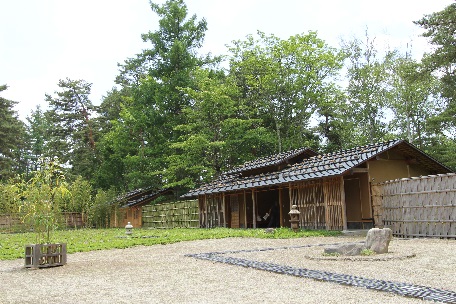
Checkered edging around the dry landscape of bamboo residence "refers tile" is obtained by communion during the tile-roofing sort of Kyoto Arashiyama Tenryu temple Tatchu "TakaraGenin (Hogon'in)", of the tile It was tile thing that used 900 sheets. Fun in the number of tiles also enjoy, you are playing superbly in modern appearance even in old tile. Design has been with those obtained in their own original Mr. Kiyoshi late Yasui, the idea on the floor pasting of checkered pattern that lies between the Katsura Imperial Villa MatsuKototei scratch.
(Ke) Nobedan of "true"
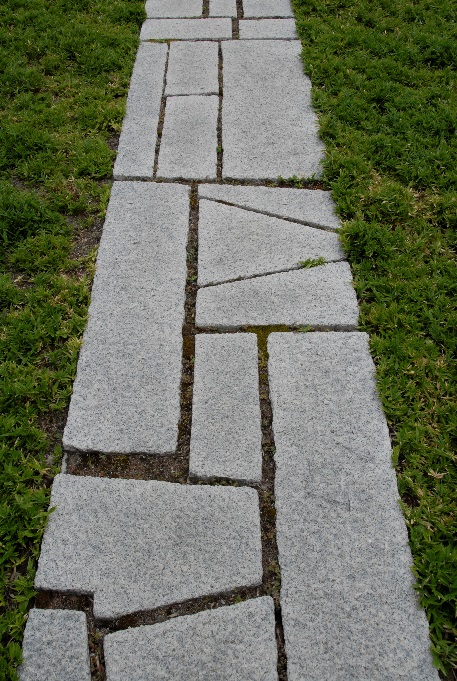
Out of the waiting return the Enro of "true black stone", and follow the Enro toward the tea room "箬庵", there is a total stage of the "true (Shin)". Enro lead continued directly to tea house on the design of subsequent to the waiting missed the plum seen Gate from outside the open field with the "grass (yes)," "line (Line)" will be the design of the "true". "True" "row" in the design of Enro "grass" corresponds to the "block letters", "line format", "cursive" in Chinese characters, is a form of "true" is well-equipped and most prestigious high. It is what paved the plate-like stone. "Grass" is a tasteful form of free break without being bound to the form, such as "Hail spilling". "Row" is the middle of a design that combines the design of "grass" and "true". The Japanese garden has become the stone that will yield to Tateshina and black stones true which is a material that is indispensable (Maguroishi) to build with the inclusion and quarried stone. Toward the tea room, which is the center of bamboo palace Along with "grass", "row", "true", within the mind, which has been apart advances the total stages of the "grass", "row", "true",'re gradually, hope finally to the tearoom firmly set in the total stage of the "true", is also said to be the trick for as canvas for the tea room.
(Co) Han bamboo (Kawatake) and Kuretake (Kuretake)
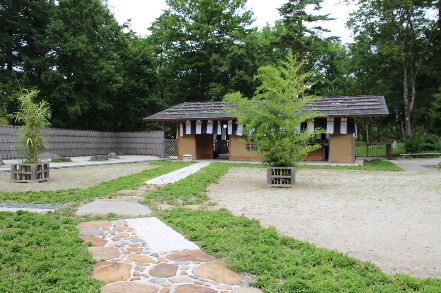
Leading to the tea room "箬庵" to the left of the total stages of the "true", is surrounded by a fence, "Han bamboo", "Kuretake" has erected to the right. It can also be seen in the cool hall of the Kyoto Imperial Palace, also has been incorporated Ya of Imperial Palace culture in bamboo palace. Initially, a soft-dono Medake (female bamboo) as "Han bamboo", but was Lophatherum gracile (irresistible force) is erected as "Kuretake", because Lophatherum gracile has withered to flowering, is currently Hotei bamboo (Phyllostachys Aurea) is erected you have. In the "bamboo Rikyu", taking into account the climate is Yatake (pseudosasa japonica) as "Han bamboo", Lophatherum gracile as "Kuretake" (irresistible force) has erected.