
Osaka Science Museum Guide
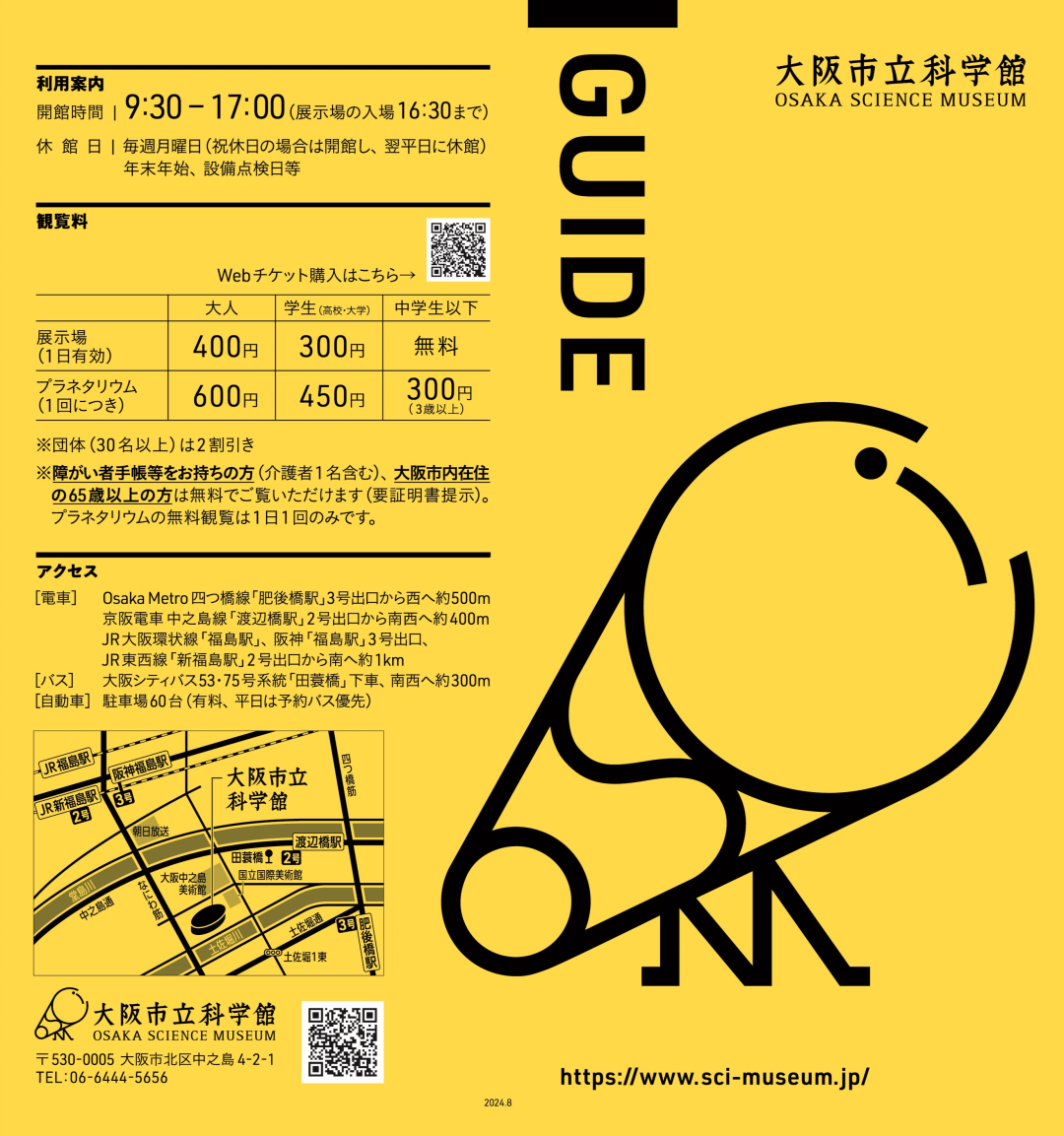
Opening hours: 9:30 - 17:00 (entrance to exhibition hall until 16:30)
Closed: Every Monday (open on public holidays and closed the following weekday), New Year's holidays, equipment inspection days, etc.
Admission fee
Exhibition Hall (valid for 1 day)
Adults: 400 yen
Students (high school and university): 300 yen
Junior high school students and younger: Free
Planetarium (per session)
Adults: 600 yen Students (high school and university): 450 yen Junior high school students and younger: 300 yen (3 years and older)
*20% discount for groups (30 or more) *Persons with a disability certificate (including one caregiver) and Osaka City residents aged 65 or older may enter for free (certificate must be presented). Free viewing of the planetarium is limited to one time per day.
access
[train]
Approximately 500m west from Exit 3 of Higobashi Station on the Osaka Metro Yotsubashi Line
About 400m southwest from Exit 2 of Watanabebashi Station on the Keihan Nakanoshima Line
Approximately 1km south from Exit 3 of Fukushima Station on the JR Osaka Loop Line, Exit 2 of Shin-Fukushima Station on the Hanshin Line, or Exit 3 of Shin-Fukushima Station on the JR Tozai Line
[bus]
Take Osaka City Bus Route 53 or Route 75 and get off at "Taminobashi" stop. Walk about 300m southwest.
[car]
Parking for 60 cars (paid, priority given to reserved buses on weekdays)
address
Osaka Science Museum 4-2-1 Nakanoshima, Kita-ku, Osaka 530-0005
telephone number
06-6444-5656
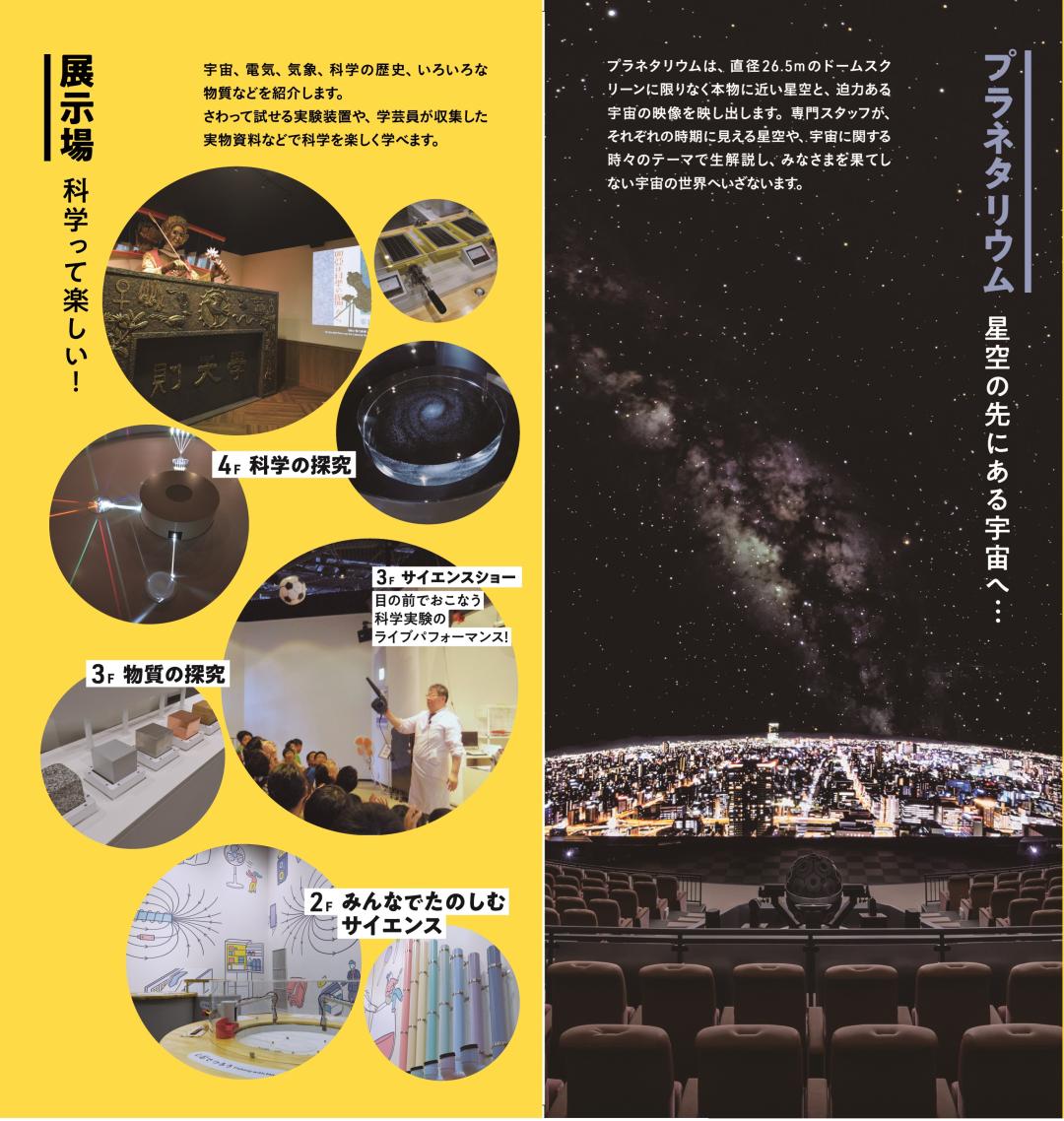
☆Exhibition hall
Science is fun!
We will introduce topics such as space, electricity, weather, the history of science, and various materials.
You can have fun learning about science through touchable experimental equipment and actual materials collected by the curators.
4th Floor: Scientific Exploration
3rd Floor: Exploration of Materials
3rd Floor: Science Show A live performance of science experiments right before your eyes!
2nd Floor: Science for Everyone to Enjoy
☆Planetarium
To the universe beyond the starry sky...
The planetarium projects a realistic starry sky and powerful images of the universe onto a 26.5m diameter dome screen. Specialized staff will give live commentary on the starry sky visible at each time of year and space-related themes, guiding you into the boundless world of the universe.
 Ticket Counter
 Information
 Information counter
 Coin lockers
 Museum Shop
 Cafe
 Nursing room
 Elevator
 escalator
 Stairs
 toilet
 Multipurpose toilet
 Ostomates
 Care bed
 AED
Ostomate and care beds are available on the basement floor.
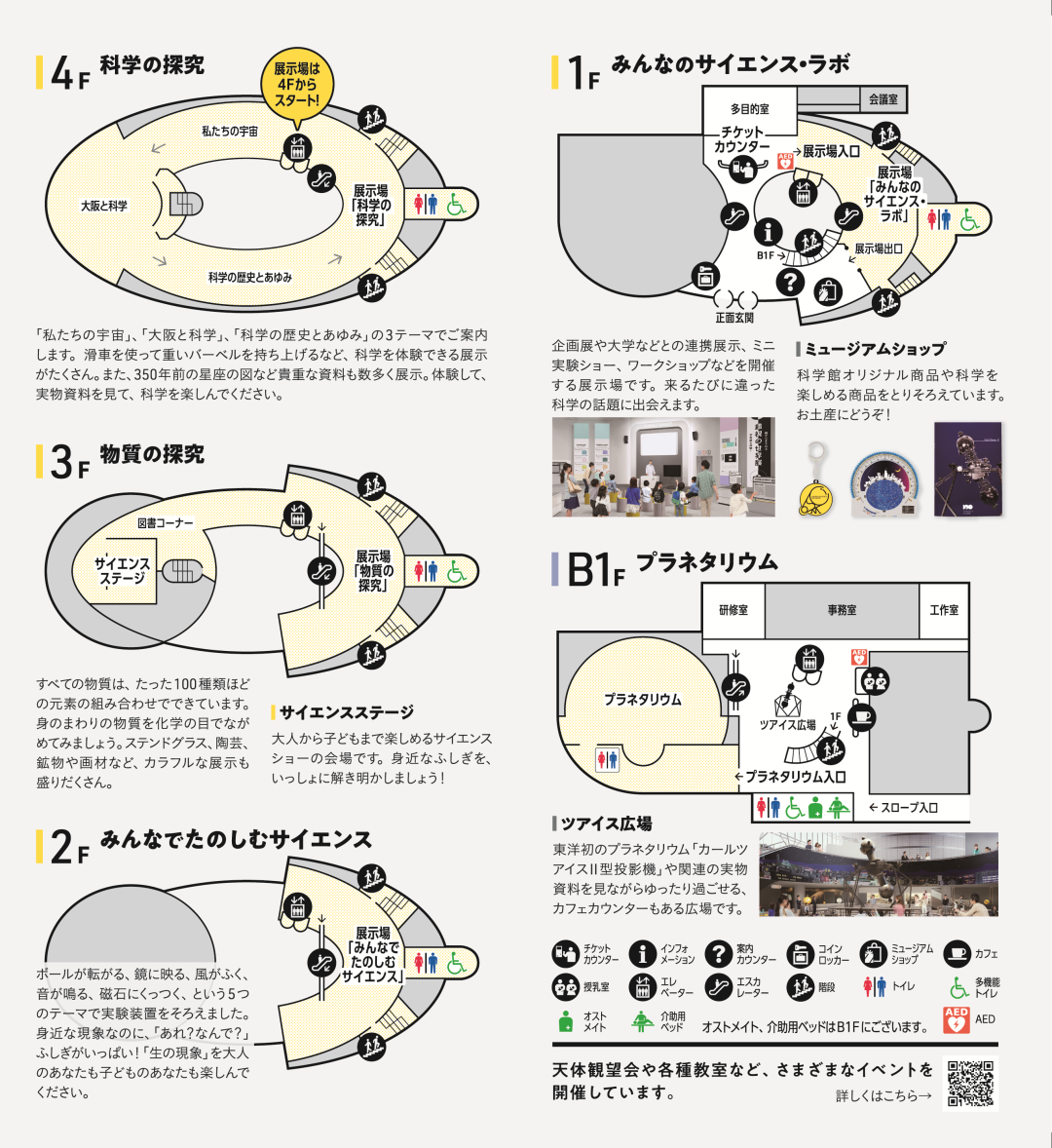
4th Floor: Scientific Exploration
The exhibition will cover three themes: "Our Universe," "Osaka and Science," and "The History and Progress of Science."
There are many exhibits where you can experience science, such as lifting a heavy barbell using a pulley.
Additionally, many valuable materials are on display, including charts of constellations from 350 years ago.
Experience it, see the actual materials, and have fun with science.
3rd Floor: Exploration of Materials
All matter is made up of combinations of just 100 or so elements.
Let's look at the substances around us from a chemical perspective.
There are also lots of colorful exhibits, including stained glass, ceramics, minerals and art supplies.
Science Stage
This is the venue for a science show that can be enjoyed by both adults and children.
Let's solve the mysteries of everyday life together!
2nd Floor: Science for Everyone to Enjoy
We have prepared experimental equipment based on five themes: a rolling ball, reflection in a mirror, wind blowing, sound making, and sticking to a magnet.
Even though it's a familiar phenomenon, it's full of mysteries that make you wonder, "Huh? Why?"
Whether you're an adult or a child, we hope you enjoy the ``phenomenon of life.''
1st floor: Science Lab for Everyone
This is an exhibition space that hosts special exhibitions, collaborative exhibitions with universities, mini experiment shows, workshops, and more.
Every time I come I encounter a different science topic.
Museum Shop
We have a wide selection of original science museum products and products that will help you enjoy science.
Please take it as a souvenir!
B1 Planetarium
Zeiss Square This square also has a cafe counter where you can relax while looking at the first planetarium in the East, the "Carl Zeiss II Projector," and related actual exhibits.