
Information of Sado Kinzan exhibition hall
Exhibition 1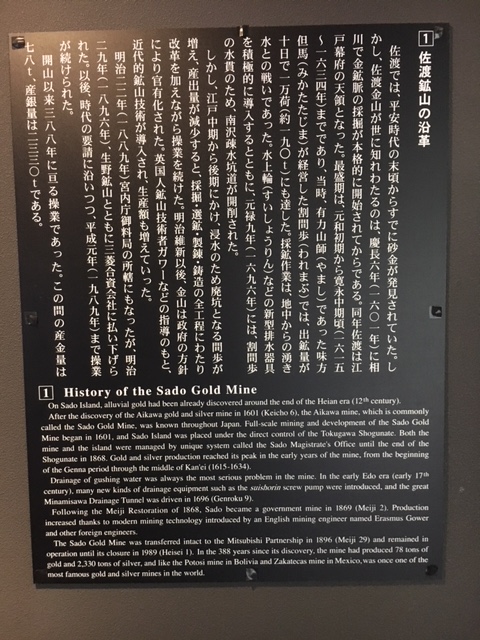
1. History of the Sado Gold Mine
On Sado Island , alluvial gold had been already discovered around the end of the Heian era (12th century).
After the discovery of the Aikawa gold silver mine in 1601 (keicho 6), the Aikawa mine, which is commonly called the Sado Gold Mine, was known throughout Japan.
Full-scale mining and development of the Sado Gold Mine began 1601, and Sado Island was placed under the direct control of the Tokugawa Shogunate.
Both the mine and the island were managed by unique system called the Sado Magistrate's Office until the end of the Shogunate in 1868.
Gold and silver production reached its peak in the early years of the mine, from the beginning of the Genna period through the middle of Kanei (1615-1634).
Drainage of gushing water was always the most serious problem in the mine, in the early Edo era (early 17th century), many new kinds of drainage equipment such as the suishorin screw pump were introduced, and the great Minamisawa Drainage Tunnel was driven in 1868 (Genroku 9).
Following the Meiji Restoration of 1868, Sado became a government mine in 1869 (Meiji 2).
Production increased thanks to modern mining technology introduced by an English mining engineer named Erasmus Gower and other foreign engineers.
The Sado Gold Mine was transferred intact to the Mitsubishi Partnership in 1896 (Meiji 29) and remained in operation until its closure in 1989 (Heisei 1).
In the 388 years since its discovery, the mine had produced 78 tons of gold and 2,330 tons of silver, and like the Potosi mine in Bolivia and Zacatecas mine in Mexico, was once one of the most famous gold and silver mines in the world.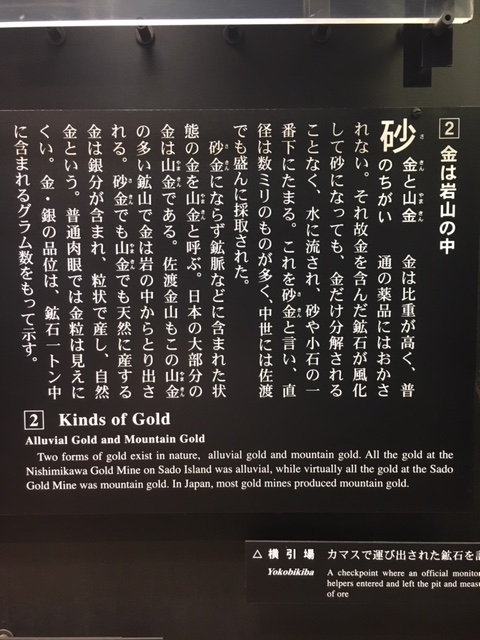
2. Kind of Gold
Alluvial Gold and Mountain Gold
Two forms of gold exist in nature, alluvial gold and mountain gold.
All the gold at the Nishimikawa Gold Mine on Sado Island was alluvial, while virtually all the Sado Gold Mine was mountain gold.
In Japan, most gold mines produced mountain gold.
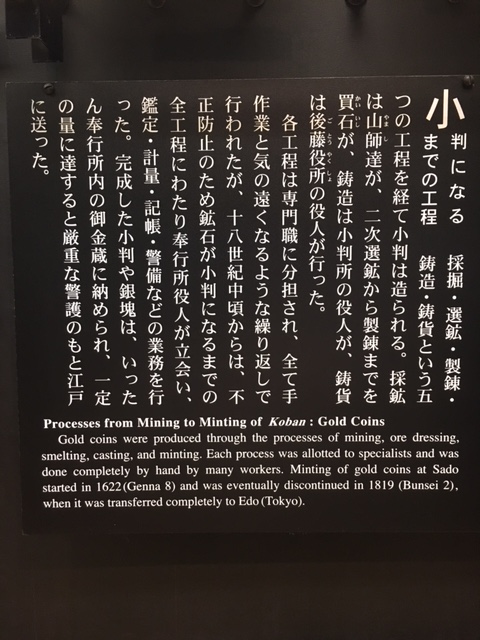
Processed from Mining to Minting of Koban : Gold Coins
Gold coins were produced through the processes of mining, ore dressing, smelting, casting, and minting.
Each process was allotted to specialists and was done completely by many workers.
Minting of gold coins at Sado started in 1622 (Genna 8) and was eventually discontinued in 1819 (Bunsei 2), when it was transferred completely to Edo (Tokyo).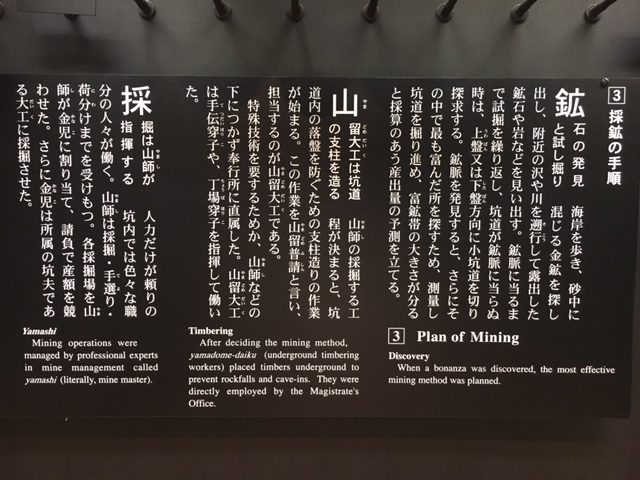
3. Plan of Mining
Discovery
When a bonanza was discovered, the most effective mining method was planned.
Timbering
After deciding the mining method, yamadome-daiku (underground timbering workers) placed timbers underground to prevent rockfalls and cave-ins.
They were directly employed by the Magistrate's Office.
Yamashi
Mining operations were managed by professional experts in mine management called yamashi (literally, mine master).
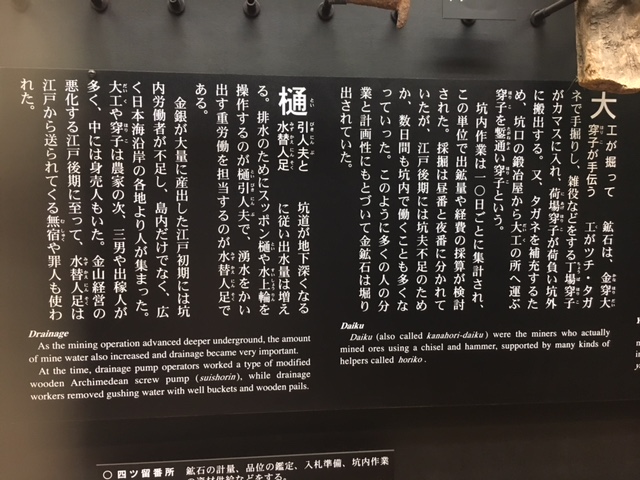
Daiku
Diaku (also called kanahori-daiku) were the miners who actually mined ores using a chisel and hammer, supported by many kinds of helpers called horiko.
Drainage
As the mining operation advanced deeper underground, the amount of mine water also increased and drainage become very important.
At the time, drainage pump operators worked a type of modified wooden Archimedean screw pump (suishorin), while drainage workers removed gushing water with well buckets and wooden pails.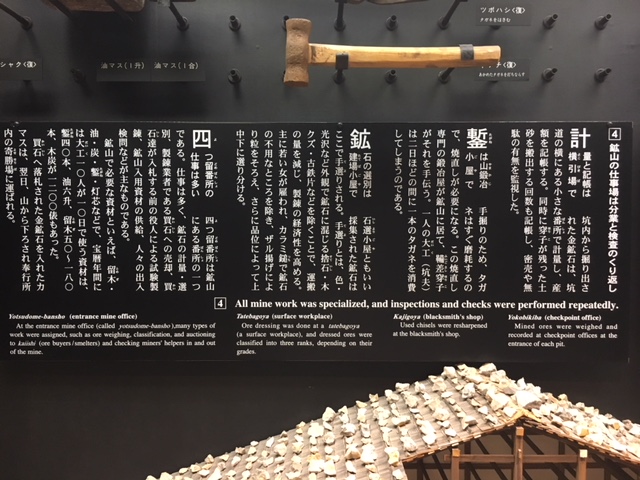
4. All mine work was specialized, and inspections and checks were performed repeatedly.
Yokobikiba (checkpoint office)
Mined ores were weighed and recorded at checkpoint offices at the entrance of each pit.
Kajigoya (blacksmith's shop)
Used chisel were resharpened at the blacksmith's shop.
Tatebagoya (surface workplace)
Ore dressing was done at a tatebagoya (a surface workplace), and dressed ores were classified into three ranks, depending on their grades.
Yotsudome-bansho (entrance mine office)
At the entrance mine office (called yotsudome-bansho),meny types of work were assigned, such as ore weighing, classifucation, and auctioning to kaiishi (ore buyers / smelters) and checking miners' helpers in and out of mine.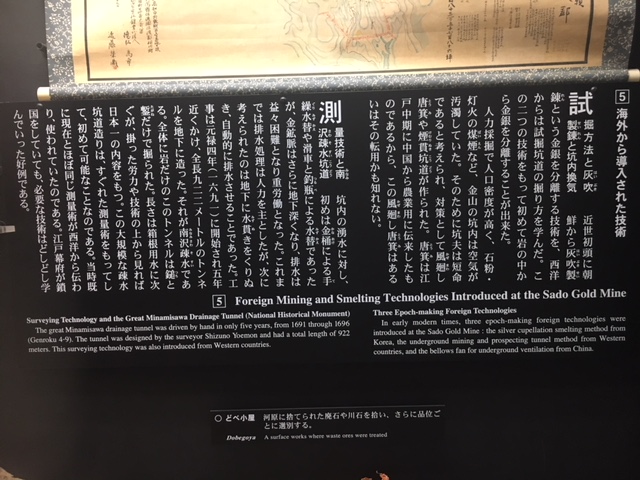
5. Foreign Mining and Smelting Technologies Introduced at the Sado Gold Mine
Three Epoch-making Foreign Technologies
In early modern times, three epoch-making foreign technologies were introduced at the Sado Gold Mine : the silver cupellation smelting method from Korea, the underground mining and prospecting tunnel method from Western countries, and bellows fan for underground ventilation from China.
Surveying Technology and Great Minamisawa Drainage Tunnel (National historical Monument)
The great Minamisawa drainage tunnel was driven by hand in only five years, from 1691 through 1696 (Genroku 4-9).
The tunnel was designed by the surveyor Shizumo Yoemon and had a total length of 922 meters.
This surveying technology was introduced from Western countries.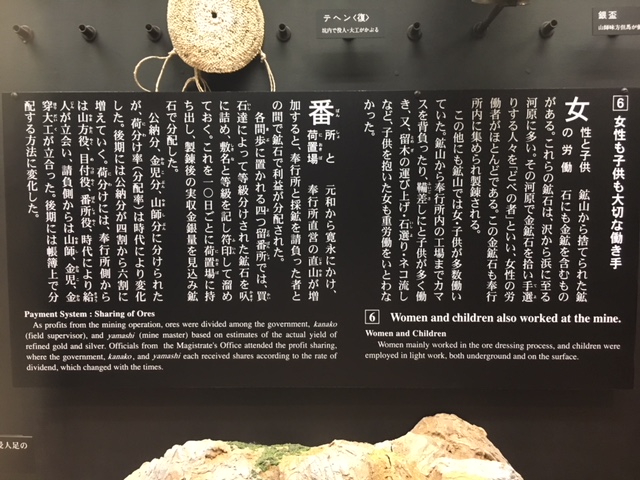
6. Women and children also worked at the mine
Women and Children
Women mainly worked in the ore dressing process, and children were employed in light work, both underground and the surface.
Payment System : Sharing of Ores
As profits from the mining operation, ores were divided among the government, kanako (field supervisor), yamashi (mine master) based on estimates of the actual yield of (refined) gold and silver.
Officials from the Magistrate's Office attended the profit sharing, (where) the government, kanako, and yamashi each received shares according to the rate of dividend, which changed with the times.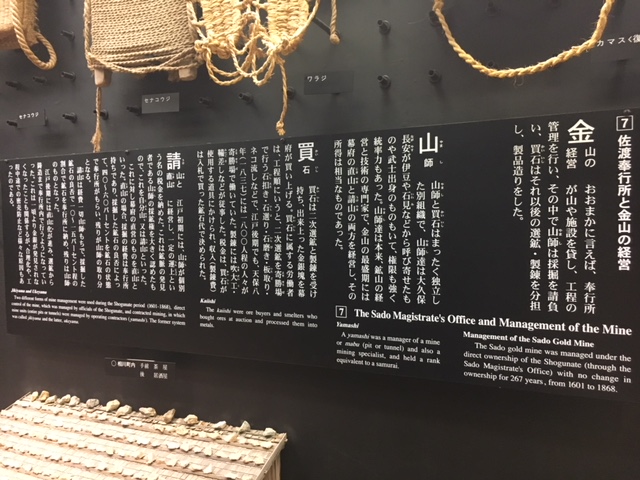
7. The Sado Magistrate's Office and Management of the Mine
Management of the Sado Gold Mine
The Sado gold mine was managed under the direct ownership of the Shogunate (through the Sado Magistrate's Office) with no change in ownership for 267 years, from 1601 to 1868.
Yamashi
A yamashi was a manager of a mine or mabu (pit or tunnel) and also a mining specialist, and held a rank equivalent to a samurai.
Kaiisi
The Kaiishi were ore buyers and smelters who bought ores at auction and processed them into metals.
Jikiyama and Ukeyama
Two different forms of mine management were used during the Shogunate period (1601 - 1868), direct control of the mine, which was managed by officials of the Shogunate, and contracted mining, in which mine units (entire pits or tunnels) were managed by operating contractors (yamashi).
The former system was called jikiyama and the latter, ukeyama.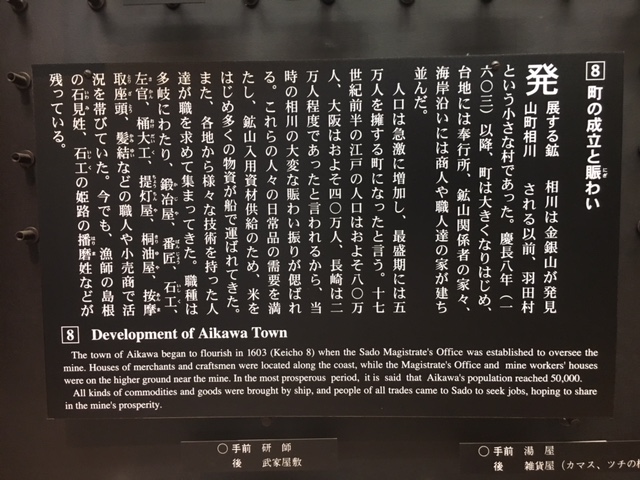
8. Development of Aikawa Town
The town of Aikawa began to flourish in 1603 (Keicho 8) when the Sado Magistrate's Office was established to oversee the mine.
Houses of merchants and craftsmen were located along the coast, while the Magistrate's Office and mine workers' houses were on the higher ground near the mine.
In the most prosperous period, it is said that Aikawa's population reached 50,000.
All kinds of commodities and goods were brought by ship, and people of all trades came to Sado to seek jobs, hoping to share in the mines prosperity.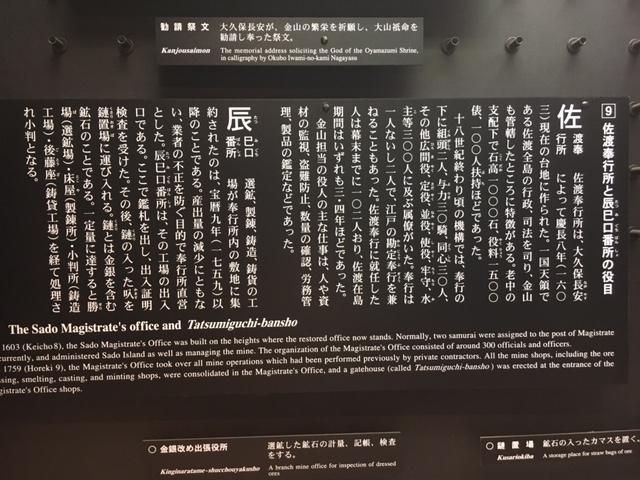
9. The Sado Magistrate's Office and Tatsumiguchi-bansho
In 1603 (Keicho 8), the Sado Magistrate's office was built on the heights where the restored office now stands.
Normally, two samurai assigned to the post of Magistrate concurrently, and administered Sado Island as well as managing the mine.
The organization of the Magistrate's Office consisted of around 300 officials and officers.
In 1759 (Horeki 9), the Magistrate's Office took over all mine operations which had been performed previously by private contractors.
All the mine shops, including the ore dressing, smelting, casting, and minting shops, were consolidated in the Magistrate's office, and a gatehouse (called Tatsumiguchi-bansho) was erected at the entrance of the Magistrate's Office shops.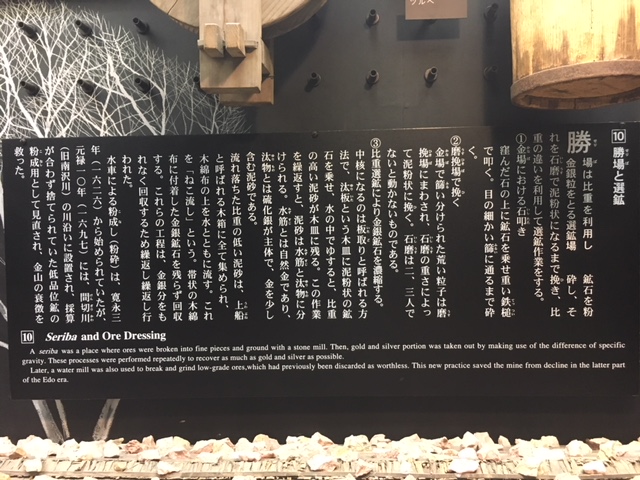
10. Seriba and Ore Dressing
A seriba was a place where ores were broken into fine pieces and ground with a stone mill.
Then, gold and silver portion was taken out by making use of the difference of specific gravity.
These processes were performed repeatedly to recover as much as gold and silver as possible.
Later, a water mill was also used to break and grind low-grade ores, which had previously been discarded as worthless.
This new practice saved the mine from decline in the latter part of the Edo era.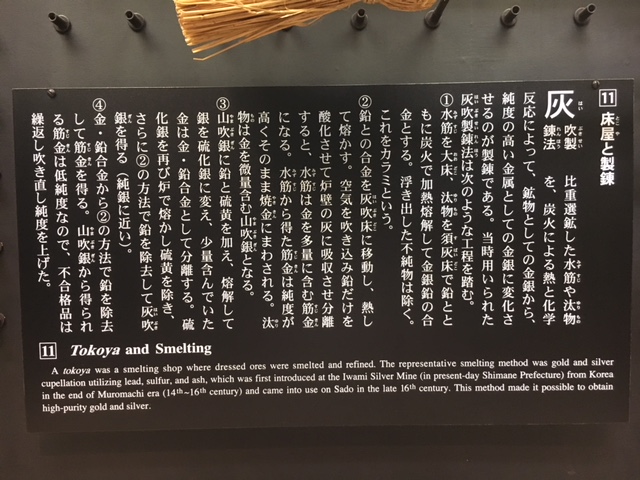
11. Tokoya and Smelting
A tokoya was a smelting shop where dressed ores were smelted and refined.
The representative smelting method was gold and silver cupellation utilizing lead, sulfur, and ash, which was first introduced at the Iwami Silver Mine (in present-day Shimane Prefecture) from Korea in the end of Muromachi era (14th ~ 16th century) and came into use on Sado in the late 16th century.
This method made it possible to obtain high-purity gold and silver.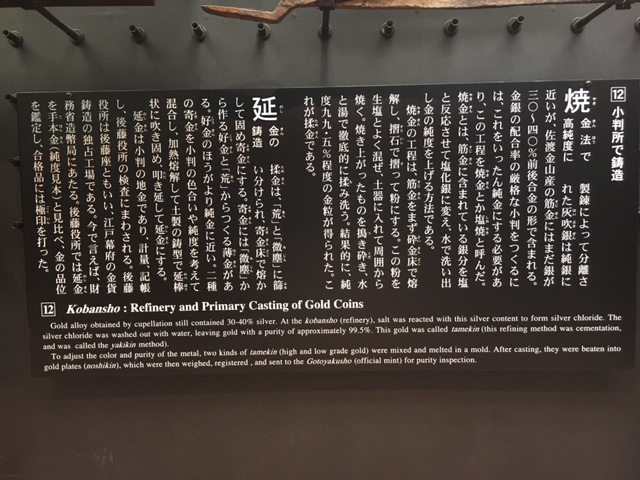
12.Kobansho : Refinery and Primary Casting of Gold Coins
Gold alloy obtained by cupellation still contained 30-40% silver.
At the kobansho (refinery), salt was reacted with this silver content to form silver chloride.
The silver chloride was washed out with water, leaving gold with a purity of approximately 99.5%.
This gold was called tamekin (this refining method was cementation, and was called the yakikin method).
To adjust the color and purity of the metal, two kinds of tamekin (high and low grade gold) were mixed and melted in a mold.
After casting, they were beaten into gold plates (noshikin), which were then weighed, registered, and sent to the Gotoyakusho (official mint) for purity inspection.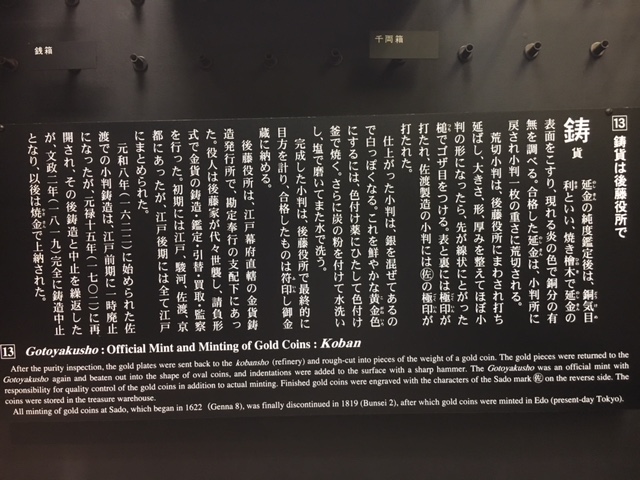
13. Gotoyakusho : Official Mint and Minting of Gold Coins : Koban
After the purity inspection, the gold plates were sent to the kobansho (refinery) and rough-cut into pieces of the weight of a gold coin.
The gold pieces were returned to the Gotoyakusho again and beaten out into the shape of oval coins, and indentations were added to the surface with a sharp hammer.
The Gotoyakusho was an official mint with responsibility for quality control of the gold coins in addition to actual minting.
Finished gold coins were engraved with the characters of the Sado mark  on the reverse side.
The coins were stored in the treasure warehouse.
All minting of gold coins at Sado, which began in 1622 (Genna 8), was finally discontinued in 1819 (Bunsei 2), after which gold coins were minted Edo (present-day Tokyo).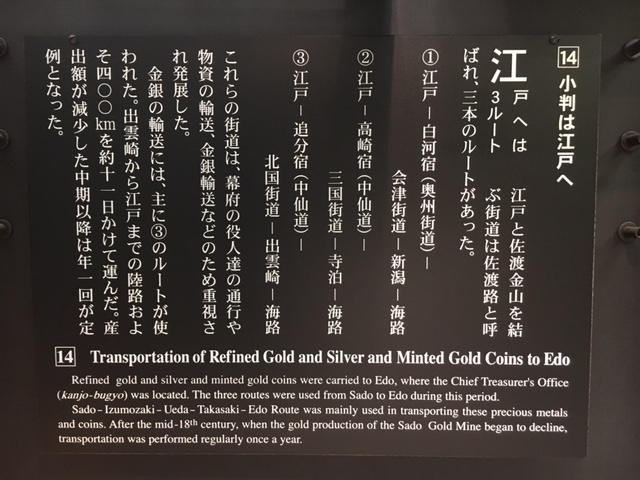
14. Transportation of Refined Gold and Silver and Minted Gold Coins to Edo
Refined gold and silver and minted gold coins were carried to Edo, where the Chief Treasurer's Office (kanjo-bugyo) was located.
The three routes were used from Sado to Edo during this period.
Sado - Izumozaki - Ueda - Takasaki - Edo Route was mainly used in transporting these precious metals and coins.
After the mid-19th century, when the gold production of the Sado Gold Mine began to decline, transportation was performed regularly once a year.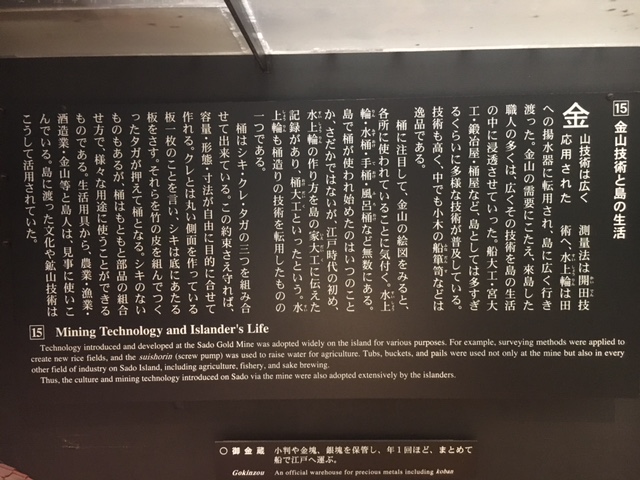
15. Minting Technology and Islander's Life
Technology introduced and developed at the Sado Gold Mine was adopted widely on the island for various purposes.
For example, surveying methods were applied to create new rice fields, and the suishorin (screw pump) was used to raise water for agriculture.
Tubs, buckets, and pails were used not only at the mine but also in every other field of industry on Sado Island, including agriculture, fishery, and sake brewing.
Thus, the culture and mining technology introduced on Sado via the mine were also adopted extensively by the islanders.
Exhibition 2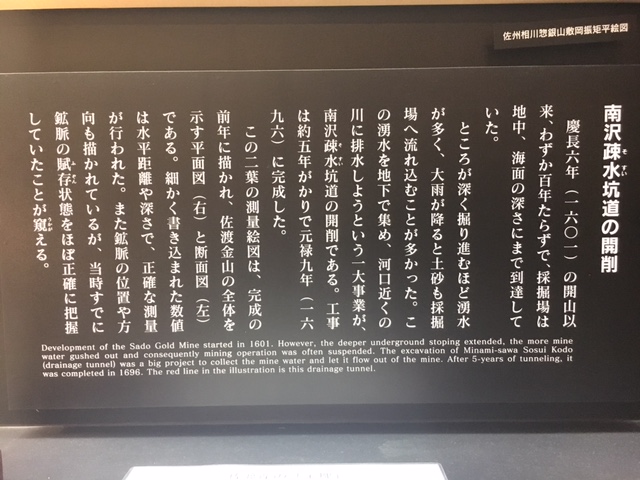
Development of the Sado Gold Mine started in 1601. However, the deeper underground stoping extend, the more mine water gushed out and consequently mining operation was often supended. The excanvation of Minami-sawa Sosui Kodo (drainage tunnel) was a big project to collect the mine water and left it flow out of the mine. After 5-years of tunneling, it was completed in 1696. The red line the illustraion is this drainage tunnel.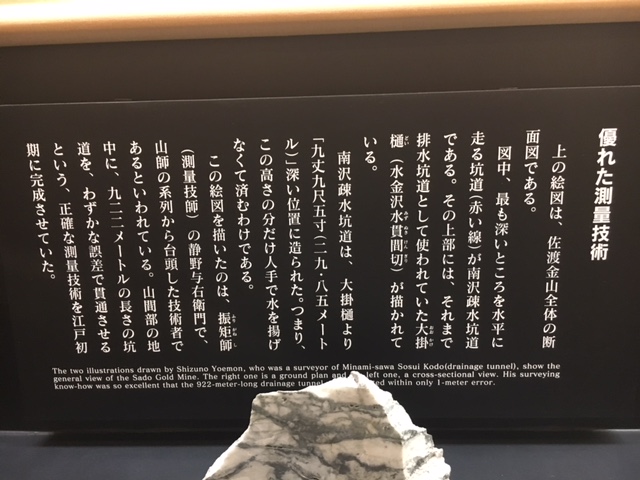
The two illustration drawn by Shizuno Yoemon, who was a surveyor of Minami-sawa Sosui Kodo(drainage tunnel), show the general view of Sado Gold Mine. The right one is a ground plan and the left one, a cross-sectional view. His surveying know-how was so excellent that the 922-meter-long drainage tunnel was completed within only 1-meter error. 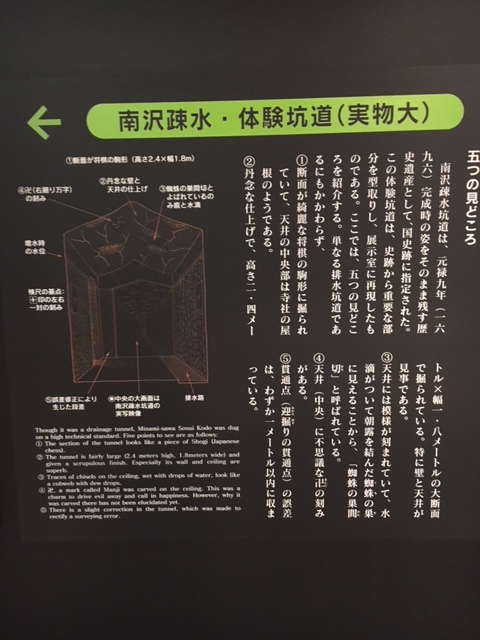
Though it was a drainage tunnel, Minami-sawa Sosui Kodo was dug on a high technical standard. Five points to see are as follows:
① The section of the tunnel looks like a piece of Shogi (Japanese chess).
② The tunnel is fairly large (2.4meters high, 1.8meters wide) and given a scrupulous finish. Especially its wall and ceiling are superb.
③ Traces of chisels in the ceiling, wet with drops of water, look like a cobweb with dew drops.
④ 卍, a mark called Manji was carved on the ceiling. This was a charm to drive evil away and call in happiness. However, why it was carved there has not been elicidated yet.
⑤ There is aslight correction in the tunnel, which was made to rectify a surveying error.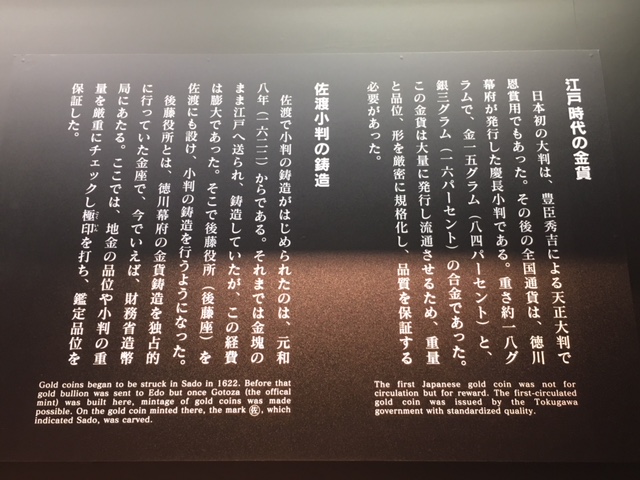
The first Japanese gold coin was not for circulation but for reward. by the Tokugawa goverment with standardized quality.
Gold coins began to be stuck in Sado in 1622. Before that gold bullion was sent to Edo but once Gotoza (the official mint) was built here, mintage of gold coins was made possible. On the gold coin minted there, the mark  , which indicated Sado, was carved.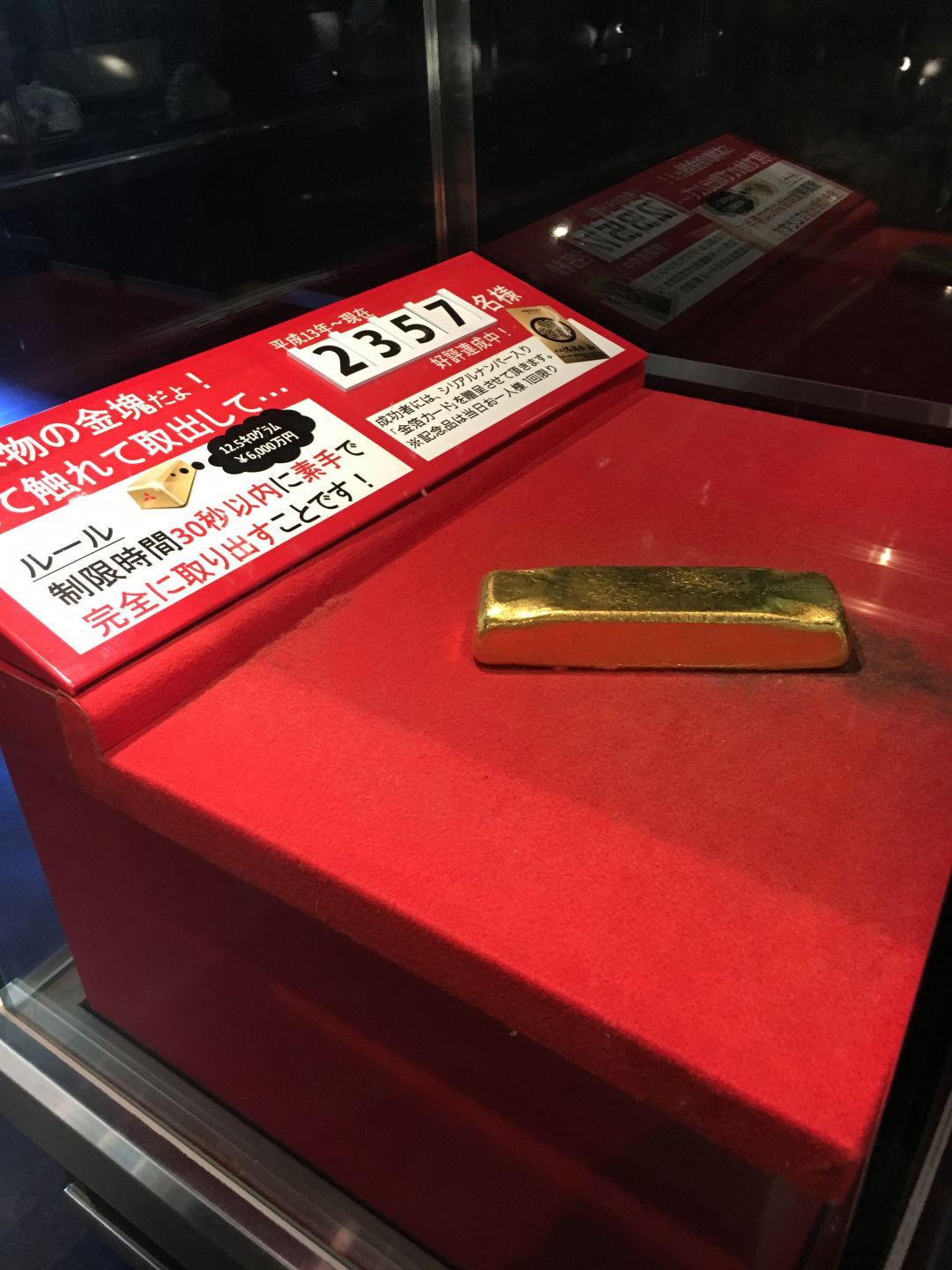
This is a real bar of gold!
Feel free to touch it or even take it out of the box if you can.
It weighs 12.5kg (28lbs) and is worth 60 million JPY, or 600,000 USD (100JPY = 1USD).
Rules: Challengers must completely remove this gold bar from the box (using their bare hands) within 30 seconds.
Those who have succeeded will receive a small gold card with a serial number.
Sorry, we are not going to give successful people this gold bar itself!
So far, xxxxx participants have successfully completed this challenge since 2001.
Note: Each successful participant is eligible to receive one card a day.